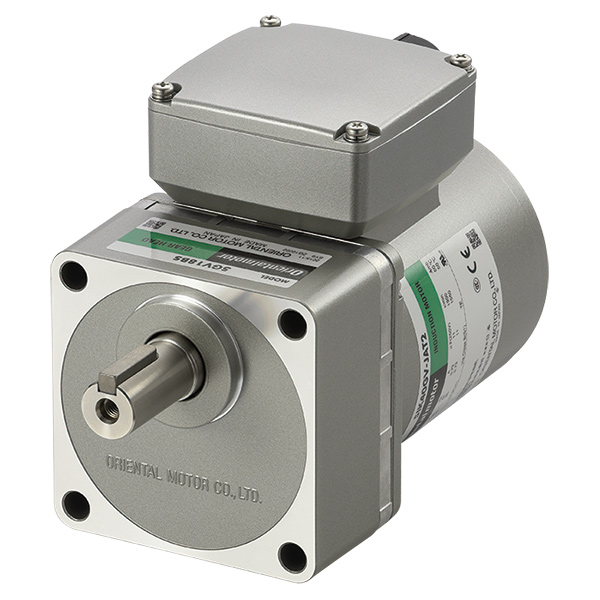
KIIS Series three-phase induction gear motor with parallel-shaft gearhead and IP66 terminal box
About the Oriental Motor AC Induction, Reversible & Gear Motors
Oriental Motor AC motors are compact, fractional-output motors for constant-speed applications. Induction motors suit continuous running in one direction; reversible motors include a simple friction brake for frequent start, stop and direction changes; and electromagnetic-brake motors hold the load when the power is off.
Each motor pairs with an Oriental Motor gearhead to become an AC gear motor with the exact output speed and torque your machine needs. Parallel-shaft gearheads cover most applications, and right-angle hollow-shaft gearheads save space by mounting directly on the driven shaft.
AB Automation supplies genuine Oriental Motor AC induction and gear motors across India, including replacements for motors already fitted on imported machines. Send us the nameplate or model number and we will confirm the equivalent.
A standard Oriental Motor AC motor is a four-pole, capacitor-run induction motor built for fixed-speed duty. Its speed is set by the supply frequency and the number of poles, so on India's 50 Hz mains the synchronous speed is 1500 r/min and, at rated torque, the shaft actually turns at roughly 1200 to 1300 r/min. A single-phase motor needs only the capacitor supplied with it; a three-phase motor connects straight to the supply with no capacitor at all. That simplicity is why these motors are still the default choice for conveyors, turntables, doors and machine auxiliaries that just need to run when switched on.
Most of these motors are used as gear motors. The motor's pinion shaft engages a separately mounted or factory-assembled gearhead, which brings the speed down to what the machine needs and multiplies the torque. The limit on a gear motor is usually not the motor itself but the permissible torque of the gearhead, which depends on gearhead type and ratio. This is why Oriental Motor publishes permissible-torque tables per ratio, and why the same motor can be paired with a parallel-shaft gearhead for general duty or a right-angle gearhead where space is tight.
Oriental Motor has been developing compact AC motors since the H Series of 1951, followed by the K Series (1966), the new K Series (1987), World K (2003) and today's KII and KIIS generation. The newer KII family roughly doubles gearhead permissible torque and gearhead rated life compared with the previous generation, offers ratios up to 1:360 in a single gearhead, and ships as pre-assembled combination types. World K Series motors, including the long-established GN/GE gearhead combinations found on many imported machines, remain in the catalogue alongside them, which matters when you need a like-for-like replacement.
Key features
Induction, reversible and electromagnetic-brake motor types
Single-phase and three-phase types
Parallel-shaft and right-angle hollow-shaft gearheads
Compact frame sizes for machine building
Can be upgraded to speed control or brushless packages
Induction vs reversible vs electromagnetic brake motor – which type do you need?
All three types share the same basic construction and speed–torque behaviour. What changes is how they start, stop and hold. An induction motor is made for running in one direction for long periods and carries a continuous rating. Single-phase induction motors have a starting torque lower than their running torque, while three-phase motors start more strongly.
A reversible motor is a single-phase capacitor-run motor with a higher starting torque and a spring-loaded friction brake at the rear. The brake adds a small friction load so the motor reverses instantly and overruns less when switched off. Oriental Motor puts this braking force at roughly 10% of motor output torque, so it is not a holding brake. Reversible motors carry a 30-minute rating because frequent starts and reversals generate extra heat.
An electromagnetic brake motor adds a power-off activated brake: when voltage is removed, a spring presses the armature onto the brake hub and the shaft is held. Choose it whenever the load must not drift or fall after the motor stops, such as vertical lifts and inclined conveyors.
Continuous one-direction running (belt conveyor, mixer, fan drive): induction motor
Frequent start/stop or direction change (reversing conveyor, gate, indexing feed): reversible motor
Load must be held with power off (vertical conveyor, lift, inclined table): electromagnetic brake motor
Need instant stop on an induction motor without a mechanical brake: add an SB50W brake pack
How to select an AC gear motor – ratio, torque and gearhead (selection guide)
Start from the speed the machine needs at the output shaft, then work back to the ratio. Divide the motor's rated speed at your supply frequency (around 1200–1300 r/min at 50 Hz) by the required output speed and pick the nearest standard ratio. Remember that motors specified for 60 Hz on an imported machine will run about 17% slower on Indian 50 Hz mains, so the ratio may need to change to keep the same line speed.
Next, calculate the load torque at the gearhead output and multiply it by a safety factor. Compare the result with the permissible torque in Oriental Motor's table for that motor and ratio, not just with motor torque times ratio: at high ratios the gearhead's mechanical strength becomes the limit, and the table already allows for gear efficiency (around 90% for one GN gear stage, falling as stages are added).
Finally, check the mechanical side: overhung load from a chain or belt sprocket, thrust load, and load inertia if you use a brake or brake pack to stop quickly. KII Series gearheads roughly doubled permissible overhung and thrust loads over the previous generation, which often allows a smaller motor to be used.
Output speed (r/min) = motor rated speed ÷ gear ratio
Required torque = load torque × safety factor; must be within the permissible torque for the chosen ratio
Check permissible overhung load at the sprocket position and permissible thrust load
Check permissible load inertia when stopping with an electromagnetic brake or brake pack
Keep supply voltage within ±10% of rating – torque varies roughly with the square of voltage
Parallel-shaft vs right-angle gearheads
Parallel-shaft gearheads keep the output shaft in line with the motor and cover the widest range of ratios and torques. They suit most conveyors, rollers and chain drives where there is room for the motor to stick out.
Right-angle gearheads turn the drive through 90°, so the motor can run alongside a conveyor frame instead of projecting from it. World K right-angle gearheads use worm gearing in solid or hollow shaft form. The BH and KIIS families use hypoid gearing, which Oriental Motor's own technical article describes as typically 95–99% efficient against roughly 40–85% for worm sets, with less heat and no running-in period. A hollow-shaft right-angle gearhead mounts straight onto the driven shaft, removing the coupling, sprockets and mounting plate.
Gearhead life, service factor and permissible torque
Oriental Motor defines gearhead rated life at permissible torque, uniform load and the reference input speed: 10,000 hours for KII and World K GE-S parallel-shaft gearheads, and 5,000 hours for the previous-generation gearheads. Actual life is estimated from three factors: the ratio of actual to reference input speed, the load factor (operating torque ÷ permissible torque, which enters the formula cubed) and a load-type factor.
The load-type factor is 1.0 for a uniform load such as a belt conveyor running in one direction, 1.5 for frequent starting and stopping, and 2.0 for frequent instantaneous reversing of reversible motors or frequent stopping with a brake pack. In practice this means a gearhead running at half its permissible torque lasts far longer than one running close to the limit, so choosing one size up for a reversing or high-cycle application is often cheaper than replacing gearheads.
Life L = rated life × (reference speed ÷ actual speed) ÷ (load factor³ × load-type factor)
Replace the single-phase motor capacitor as a maintenance item – standard rated conduction time is 25,000 hours
Replacing an Oriental Motor gear motor on an imported machine
Many Japanese, Korean, Chinese and European machines running in Indian plants use Oriental Motor AC gear motors, often labelled with part numbers such as 4IK25GN-AW2 plus a 4GN□K gearhead. The part number itself describes the motor: the first digit is the frame size (for example 4 = 80 mm, 5 = 90 mm), I or R indicates induction or reversible, the number after K is output in watts, and the following letters give the voltage and lead type. The number in the gearhead part number is its ratio.
The most common trap is voltage and frequency. A machine built for 100 V or 200 V, 60 Hz will usually need the 220/230 VAC motor version for single-phase supply in India, and the output speed will drop at 50 Hz unless the ratio is changed. Motors and gearheads must be the same frame size and pinion type to mesh, and a newer KII motor is not always interchangeable with an older gearhead. Send us both nameplates and we will confirm the correct current model.
When to move beyond a constant-speed AC gear motor
A constant-speed AC gear motor is the simplest and most economical answer when one fixed speed is enough. If operators need to adjust speed, look at US2 or DSC speed control motors, which add a tachogenerator and controller to the same motor platform. If you need a wide speed range, stable speed under changing load, lower energy use or a much shorter motor, a brushless DC gear motor is worth the extra cost. Oriental Motor's published case studies show conveyors where switching from an AC induction gear motor to a brushless motor roughly halved motor mass and protrusion.
Specifications
Motor types
Induction (single-phase and three-phase), reversible (single-phase), electromagnetic brake (power-off activated)
Output power
Induction 1 W – 200 W; reversible 1 W – 90 W; electromagnetic brake types from 6 W
Frame sizes
42 mm to 104 mm square (200 W BH Series in 104 mm frame)
Power supply
Single-phase 110/115 VAC or 220/230 VAC; three-phase 200–230 VAC; KIIS 200 W also 380/415 VAC
Speed at 50 Hz (4-pole)
Synchronous 1500 r/min; approx. 1200–1300 r/min at rated torque, reduced by the gear ratio
Gear ratios
KII Series 1:5 to 1:360 in a single gearhead (no decimal gearhead needed above 1:180)
Gearhead permissible torque
Up to 20 N·m (World K 90 W), 40 N·m (KII reversible 90 W), 60 N·m (BH right-angle), 70 N·m (KIIS 200 W parallel shaft)
Long-established global-standard motors sold separately from GN-K/KA, GE-S or right-angle worm gearheads; lead wire, terminal box or conduit box types
1 W – 90 W gear motors; 150 W 2-pole high-speed round shaft; 110/115 or 220/230 VAC
World K Series – three-phase induction
Three-phase motors with parallel-shaft or right-angle gearheads, electromagnetic brake available
6 W – 150 W; three-phase 200–230 VAC
World K Series – reversible
Same outline as the induction motor but with a friction brake and higher starting torque for frequent reversing
1 W – 90 W; permissible torque up to 20 N·m
KII Series – induction, reversible and brake
Newer generation with voltage-optimised windings, stronger gears, pre-assembled combination types and ratios up to 1:360
6 W – 90 W; reversible gear motors up to 40 N·m
KIIS Series – three-phase induction
High-efficiency fanless three-phase motor (max. 77.8% efficiency) with parallel-shaft or right-angle hypoid gearhead; suits inverter drive from 3–120 Hz
30 W – 200 W; 220/230/240 VAC, 200 W also 380/415 VAC; up to 70 N·m
BH Series – 200 W
Compact 1/4 HP induction gear motor in a 104 mm frame with parallel-shaft or right-angle hypoid solid/hollow shaft gearhead
200 W; single-phase or three-phase; up to 60 N·m (right-angle)
Electromagnetic brake types
Power-off activated brake holds the load when power is cut, for lifts, vertical conveyors and inclined drives
6 W – 90 W (World K / KII); also on KIIS and BH three-phase
SB50W brake pack (accessory)
Adds instantaneous stop, forward/reverse control and brake control, and detects an opened thermal protector
For AC motors 1 W – 90 W
Specifications are indicative. Contact us for the exact model, availability, lead time and pricing.
Use cases
Packaging
Continuous belt conveyor on a packaging line
A single-phase induction gear motor with a parallel-shaft gearhead drives the head roller at one fixed speed through an eight-hour or longer shift. No drive or controller is needed, just the supplied capacitor and a contactor.
Simple, low-cost fixed-speed drive with continuous rating
Material handling
Reversing transfer conveyor
A reversible motor lets a short transfer conveyor send cartons left or right on command. The built-in friction brake gives instant reversal and reduces overrun without an external brake.
Instant direction change from a simple switching circuit
Warehousing
Vertical lift or inclined conveyor
An electromagnetic brake motor holds the carriage when power is removed, so the load does not drift down during stops or a power cut. It can be combined with the SB50W brake pack for instantaneous stop.
Load held in position with power off
Textile
Take-up and auxiliary drives on textile machines
Small induction gear motors run cloth take-up rolls, lint cleaners and feed rollers on looms and processing machines common in Surat's textile clusters. Replacements for motors on imported machines are matched by nameplate.
Like-for-like spares that keep imported machines running
Diamond & jewellery
Rotating display and inspection turntable
A low-power induction gear motor at a high ratio turns an inspection or display turntable at a slow, steady speed. A right-angle hollow-shaft gearhead can mount directly under the table shaft to save height.
Slow, smooth rotation in a compact footprint
Food processing
Washdown-area conveyor and mixer drives
KIIS terminal box gear motors rated IP66, or dedicated IP67/IP65 washdown motors, drive conveyors and agitators in areas that are cleaned with water. The fanless KIIS motor also avoids blowing dust around.
Suitable for wet cleaning areas
Pharmaceutical
Tablet and bottle conveyor on a pharma line
A three-phase KIIS gear motor on an inverter provides a constant, adjustable line speed for bottle or blister conveyors. Its speed range with an inverter runs from 3 to 120 Hz.
Efficient three-phase drive that also works with an inverter
Building automation
Door, shutter and gate mechanisms
Reversible or brake motors open and close small doors, dampers and gates, where the motor starts and stops often and must stop quickly at each end of travel.
Frequent start/stop duty from a standard AC supply
Conveyors and turntables
Door, shutter and gate mechanisms
Packaging and food machines
Textile machine auxiliaries
Replacement motors for imported machines
Case studies
Material handling / conveyors
Conveyor motor protrusion and weight reduced by replacing an AC induction gear motor
Challenge
Conveyors built into compact equipment had limited space at the side, and a 200 W AC induction gear motor with an equivalent torque rating was bulky, heavy and less efficient than required.
Solution
Oriental Motor compared the AC induction gear motor with a BLM brushless DC motor fitted with a hollow-shaft gearhead, which removes couplings and shortens the drive.
Result
Oriental Motor reports motor protrusion cut by about 50% (232 mm to 109 mm) and motor mass by about 50% (8 kg to 4.2 kg) on belt and chain conveyors, showing when an upgrade from an AC gear motor pays off.
Parts feeder motor section made smaller and lighter
Challenge
A vibratory parts feeder for springs and clips used a 90 W three-phase induction motor with an inverter. The long, heavy motor limited where the feeder could be installed and made maintenance harder.
Solution
The induction motor was replaced with a 120 W BMU Series brushless motor in the same 90 mm frame.
Result
According to Oriental Motor, overall motor length fell from 135 mm to 50.4 mm and mass from 3.2 kg to 1.2 kg, and the fanless design stopped dust being stirred up.
Genuine Oriental Motor products with warranty, supplied pan-India from Surat, Gujarat.
Selection calculations from your load, speed and positioning requirements.
Wiring, parameter setup, PLC integration and on-site start-up support.
Replacement models for older Oriental Motor products on existing machines.
Frequently asked questions
What is the difference between an induction motor and a reversible motor?
An induction motor is designed for continuous running in one direction. A reversible motor has a built-in friction brake and a higher starting torque, so it can change direction instantly and start and stop frequently.
Can you replace an Oriental Motor gear motor on an imported machine?
Yes. Share the motor and gearhead nameplates or model numbers and we will confirm the matching current model, availability and lead time.
What gear ratios are available?
Oriental Motor gearheads are available in a wide range of ratios to reach the output speed you need. Tell us the required speed and torque and we will select the motor and ratio.
Will a 60 Hz Oriental Motor gear motor from an imported machine work on Indian 50 Hz supply?
It will run, but about 17% slower because AC motor speed follows supply frequency, and the voltage must also match. We normally supply the 220/230 VAC version and, if the line speed matters, a gearhead with a lower ratio to compensate.
Can a reversible motor's friction brake hold a vertical load?
No. The friction brake is only about 10% of motor output torque and is meant to improve reversing and reduce overrun. For vertical or inclined loads use an electromagnetic brake motor, which holds the load when power is off.
Can I run an Oriental Motor reversible motor continuously?
Reversible motors carry a 30-minute rating. For continuous running in one direction, choose an induction motor; if a reversible motor must run longer, its case temperature should stay at or below 90 °C under your actual duty cycle.
Why must I use the capacitor supplied with a single-phase motor?
The capacitor value is matched to the motor. A different capacitance can cause vibration, overheating or loss of torque. Treat the capacitor as a maintenance item: its standard rated conduction time is 25,000 hours.
What is the difference between World K and KII Series?
World K motors are sold separately from their gearheads and remain the usual match for older machines. KII is the newer generation with voltage-optimised windings, about twice the gearhead permissible torque and rated life, quieter gears and pre-assembled motor-gearhead combinations with ratios up to 1:360.