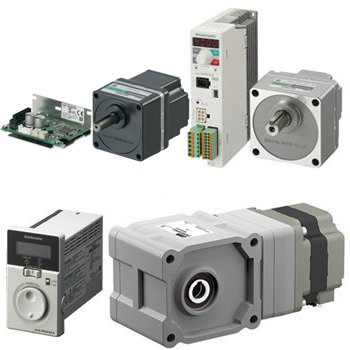
Oriental Motor brushless (BLDC) motor and driver packages — AC and DC input types
About the Oriental Motor BLV / BLE2 / BMU Brushless Motors
Oriental Motor brushless DC (BLDC) motors are speed-control motor and driver packages that are smaller and more efficient than AC induction motors of the same output. Because the driver controls speed with feedback from the motor, speed stays stable under changing load and can be set digitally over a wide range.
The BMU series is the easy-to-use choice, with speed set from a panel on the driver and outputs from 30 to 400 W. The BLE2 series, also 30 to 400 W, adds digital setting and more I/O, with parallel-shaft and right-angle hollow-shaft gearheads for high torque at low speed. The BLV Series R Type runs from a 24/48 VDC supply (60 – 400 W) with Modbus RTU or CANopen control, which suits battery-powered AGVs and mobile machines.
Replacing an AC motor and VFD with a BLDC package typically saves energy, space and wiring. AB Automation supplies genuine Oriental Motor brushless motors across India and helps you select motor output, gear ratio and control method for your conveyor, pump or machine.
Inside an Oriental Motor brushless motor the permanent magnets sit on the rotor and the three-phase windings sit in the stator. Three Hall-effect ICs, spaced 120 electrical degrees apart, tell the driver where the rotor is at every instant, and the driver switches current through the U, V and W windings in the right sequence. Because the same signals also give the actual shaft speed, the driver compares it with the set speed all the time and corrects the applied voltage. That closed loop is why speed barely moves when the load changes, and why torque stays flat from low speed to rated speed instead of dropping off the way it does on an AC speed control motor.
Every package is sold as a matched motor and driver, so there is no motor data to enter and no tuning to do. Connect the motor cable, wire the power supply and a run signal, and set the speed on the driver. The motors are also physically different from AC motors of the same output: Oriental Motor's published comparison shows a 120 W BMU motor at 84.6 mm shorter and 62% lighter than a 90 W AC motor on the same 90 mm frame. That matters on conveyors and machine frames where the motor sticks out into a walkway or has to fit inside a guard.
The range now splits into AC-input packages (BMU, BLE2 and the higher-end BX II) for mains-powered machines, and DC-input packages (BLV Series R Type, BLH and BLS) for battery-powered vehicles and 24 V control panels. All of them share the same family of combination gearheads — parallel shaft, right-angle hollow shaft, hollow-shaft flat and foot-mount types — so you can keep the gear motor footprint and change only the driver when the control requirement changes.
BLE2: 30 – 400 W with digital setting and parallel-shaft / right-angle gearheads
BLV R Type: 24/48 VDC input, 60 – 400 W for AGVs and mobile machines
I/O control; Modbus RTU / CANopen on DC-input types
Higher efficiency and smaller size than AC motors
How brushless DC speed control works
A brushless motor has no brushes or commutator to switch the current. Instead, Hall-effect ICs in the stator report rotor position to the driver, and the driver's transistors energise the windings in sequence. The same Hall signals are counted as speed feedback, so the driver knows the real shaft speed and adjusts the voltage to hold it — this is what Oriental Motor means by speed regulation of ±0.2%.
The practical result is a speed-torque curve that stays flat from 80 r/min to around 3000 r/min, with a short-time torque reserve above that for starting and acceleration. An AC motor on a VFD, by contrast, runs open loop: when load rises, slip increases and speed falls. On a conveyor feeding a filler, labeller or printer, that difference shows up directly as product spacing and print position.
Speed set on the driver (dial, keys), by external potentiometer, by 0–10 VDC or by software — no separate VFD
Flat rated torque across the speed range, so a lower gear ratio can often be used
Speed stays within ±0.2% as load, supply voltage and temperature change (digital setting)
No brush wear, sparks or carbon dust; maintenance is limited to bearings and gearhead
BMU vs BLE2 vs BLV — selection guide
Start with the power supply. If the machine runs from single-phase 230 VAC or three-phase 415/230 V control transformers, choose from the AC-input BMU and BLE2 series. If it runs from a battery or a 24/48 VDC bus — AGVs, AMRs, trolleys, mobile inspection units — choose the BLV Series R Type (or BLH/BLS for small 24 V drives).
Between BMU and BLE2, the motors and gearheads are shared; the difference is the driver. BMU is the one to choose when an operator simply needs to dial in a speed, perhaps with four preset speeds, and read the load factor. BLE2 suits machines where the PLC switches between many speeds, where you need torque limiting to protect a jam-prone mechanism, a simple holding torque at standstill, or an electromagnetic brake for a vertical axis.
Then size the output. Work out the torque at the gearhead output shaft and the required speed, choose a gear ratio that puts the motor between roughly 1000 and 3000 r/min for the normal operating point, and check permissible torque, overhung load and duty. Send us the load details and we will do the calculation.
BMU: simple dial speed setting, 4 speeds, ideal for stand-alone conveyors and operator-adjusted machines
BLE2: up to 16 speeds, torque limit, holding torque, brake types, PC software for set-up and monitoring
BX II: when you need encoder feedback and very low speed operation down to 2 r/min
BLV R Type: battery or DC supply, Modbus RTU/CANopen networking, AGV-focused functions
Need positioning rather than speed control? Look at AZ Series closed loop steppers or servo motors instead
Brushless motor vs AC motor with VFD — energy and space savings
Oriental Motor's published data puts the power consumption of a 90 W brushless motor about 26% below that of an inverter-controlled three-phase induction motor doing the same job. Their 60 W comparison, based on 12 hours a day for 300 days a year, shows an AC motor using 439.2 kWh a year against 273.6 kWh for a BMU brushless motor — a saving of 165.6 kWh per drive, per year. On a line with twenty or thirty small conveyor and feeder drives running two shifts, that adds up.
The efficiency gain comes from the permanent-magnet rotor: there is no rotor current and therefore no rotor copper loss, and the motor does not need to be oversized to cover slip and low-speed torque drop. BMU motor-and-driver efficiency is published at 86.0% for 200 W and 87.0% for 400 W, which Oriental Motor states exceeds the IE4 class value at those outputs.
A VFD still has its place. For drives above a few kilowatts, for existing motors that are already installed, or where a rugged standard induction motor is required, a VFD is usually the more economical choice. The BLDC package wins below 400 W, where it is smaller, holds speed more tightly and needs no motor parameter set-up.
Speed range 80–4000 r/min (50:1) vs a typical 200–2400 r/min (12:1) for an inverter-driven three-phase induction motor in Oriental Motor's comparison
120 W BMU motor: 1.2 kg vs 3.2 kg for a 90 W AC motor on the same 90 mm frame
One matched motor-driver package instead of motor + VFD + parameter set-up
Choosing the right gearhead
Most brushless applications need the motor's 80–4000 r/min brought down to a useful output speed with more torque, and the gearhead choice decides how the drive fits the machine. The parallel shaft (GFV) gearhead is the standard choice and the most economical; ratios run from 5:1 to 200:1 with a rated life of 10,000 hours.
The right-angle hollow shaft (JH) gearhead slides directly onto the driven shaft and turns the motor through 90°, so there is no coupling, no alignment job and far less protrusion from the side of a conveyor. The hollow-shaft flat (FR) gearhead does the same in line with the shaft, which suits narrow machines and AGV wheel modules. Foot-mount (JB) gearheads bolt down like a conventional gear motor for high-torque drives.
Tight space beside a conveyor: right-angle hollow shaft (JH)
Always check permissible torque and overhung load at the output shaft for the chosen ratio
Brushless motors for AGVs and mobile robots
Battery-powered vehicles are where the BLV Series R Type earns its place. The driver accepts a wide input range (15–55 VDC) so it keeps running as the battery discharges, and it weighs about 0.12 kg in a 65 × 75 × 29 mm package, roughly 80% smaller than Oriental Motor's previous driver. That frees space and weight for battery capacity or payload.
The R Type adds functions aimed at vehicles: speed control down to 1 r/min for smooth docking, automatic torque limiting (ATL) to prevent a stall on overload, electrical load holding at standstill, electromagnetic brake types for ramps, Safe Torque Off, and Modbus RTU or CANopen so the vehicle controller can command both drive wheels and a top conveyor over one network. Hollow-shaft flat gearheads and flange drive adapters make compact wheel modules possible.
Brush vs brushless DC motor — which should you choose?
A brushed DC motor is simple and cheap: it commutates itself mechanically and its speed can be varied just by changing the voltage. The trade-off is brush and commutator wear, carbon dust, sparking and electrical noise, which make it a poor fit for continuous-duty industrial machines, clean rooms and food areas.
A brushless motor needs a driver, which raises the initial cost, but it has no wearing electrical parts, runs quieter, is more efficient and holds speed accurately under changing load. For conveyors, AGVs and machines that run a full shift every day, the longer life and lower maintenance usually pay back the difference quickly.
Specifications
Output power
BMU and BLE2: 30, 60, 120, 200, 300 and 400 W. BLV Series R Type: 60, 100, 200 and 400 W
AC power supply (BMU, BLE2)
Single-phase 100–120 VAC, single-phase 200–240 VAC or three-phase 200–240 VAC, 50/60 Hz (permissible −15 to +10%)
DC power supply (BLV R Type)
24 VDC or 48 VDC; operating range 15–55 VDC (400 W 48 V type: 30–55 VDC)
Max. ±0.2% with digital setting (±0.5% with analogue setting) against load, voltage and temperature changes
Motor + driver efficiency (BMU)
71.8% at 30 W up to 87.0% at 400 W; 86.0% at 200 W
Gearheads
Parallel shaft (GFV), right-angle hollow shaft (JH), hollow-shaft flat (FR), foot mount (JB) and JV types; round shaft also available
Parallel shaft gear ratios
5:1 to 200:1; rated gearhead life 10,000 hours
Protection
IP66 connector-type motors as standard; IP67 watertight and H1 food-grade grease options; stainless steel shaft options
Communication (BLV R Type)
Modbus RTU (RS-485) and CANopen; Safe Torque Off (STO)
Operating ambient temperature
0 to +50°C
Product line-up
Type
Description
Key ratings
BMU Series (AC input)
Easy-to-use package: turn-and-push dial on the driver sets speed in 1 r/min steps, 4-speed operation, acceleration/deceleration setting, load factor display and dial lock.
30–400 W, 80–4000 r/min, speed regulation ±0.2%
BLE2 Series (AC input)
Advanced digital driver: up to 16 speeds, torque limiting 0–300%, acceleration/deceleration 0–15 s, simple holding torque, alarm output and MEXE02 support software. Electromagnetic brake types at 30 W and 60 W.
Encoder-equipped brushless package with torque control, for low-speed operation and applications that need more than basic speed control.
30–400 W, 2–4000 r/min
BLV Series R Type (DC input)
Battery-ready package for AGVs and AMRs with an 80% smaller compact driver, Modbus RTU / CANopen, ATL overload torque limiting and STO. Electromagnetic brake types at 100 W and 200 W.
24/48 VDC, 60–400 W, 1–4000 r/min
BLH Series (DC input)
Compact 24 VDC brushless motor and driver for small machines, with torque limiting and RS-485 support.
24 VDC, 15–100 W
BLS Series (DC input)
24 VDC package with a compact board-type driver, torque limiting and RS-485 communication.
24 VDC, 25–120 W, 100–3000 r/min
Parallel shaft gearhead (GFV)
Standard combination gearhead for conveyors and general drives; H1 food-grade grease and IP67 versions available.
Gear ratio 5:1–200:1, 10,000 h rated life
Right-angle hollow shaft gearhead (JH)
Mounts straight onto the driven shaft at 90°, removing couplings and reducing how far the motor sticks out from the machine.
IP66 combination types
Specifications are indicative. Contact us for the exact model, availability, lead time and pricing.
Use cases
Packaging
Speed-adjustable packaging conveyors
Flat-belt and modular conveyors feeding cartoners, flow wrappers and case packers need speed matched to the machine they feed. A BMU gear motor lets the operator dial in the belt speed on the driver, and the ±0.2% regulation keeps product pitch steady as the load on the belt varies.
Stable product spacing without a VFD
Printing & labelling
Synchronised print and label conveyors
Where a printer or labeller applies to products on a moving belt, speed drift moves the print position. BLE2 drivers switch between up to 16 preset speeds from the PLC and several motors can be driven at the same speed from one external potentiometer.
Consistent print and label placement
Textile
Take-up and feed rollers on textile machines
Winding, take-up and feed rollers in Surat's weaving, embroidery and processing units need steady tension over a wide speed range. A brushless gear motor delivers rated torque at low roller speed and holds that speed as the package diameter builds up.
Even tension from slow to full speed
Food & beverage
Wash-down conveyors in food processing
Conveyors in wet areas of snack, dairy and ready-food plants face water jets and cleaning chemicals. IP67 BMU/BLE2 gear motors with stainless steel shafts and H1 food-grade grease are designed for these conditions.
Motor suited to regular wash-down
Pharmaceutical
Tablet and blister feeding conveyors
Infeed and transfer conveyors on blister packing and inspection lines must hold speed exactly as batches change. BLE2 torque limiting protects the mechanism if a tablet or pack jams, and alarm output tells the PLC straight away.
Gentle, protected transfer with fault signalling
Warehousing & logistics
Drive wheels and top conveyors on AGVs
Battery-powered AGVs and AMRs use BLV Series R Type motors on the drive wheels and on a top-mounted roller or belt conveyor, all controlled over Modbus RTU or CANopen from the vehicle controller. The wide 15–55 VDC input keeps performance consistent as the battery discharges.
Smaller, lighter drive train with networked control
Chemicals & process
Agitators, mixers and dosing pumps
Small agitators and metering pumps need a speed that stays fixed as viscosity changes. The closed-loop brushless drive holds the set speed under varying load, and the load factor display shows how hard the motor is working.
Repeatable mixing and dosing speed
Gems & jewellery
Diamond sorting and inspection conveyors
Vision-based sorting and inspection stations in Surat's diamond units move small, valuable stones past cameras at a fixed pace. A compact brushless gear motor gives smooth, quiet motion at low speed without brush dust near the optics.
Smooth, clean low-speed motion near cameras
Conveyors and material handling
AGVs and mobile robots
Pumps, fans and mixers
Packaging and food machines
Textile machines
Case studies
Agriculture & food
BMU brushless gear motor automates baby-leaf cleaning at a hydroponic vegetable farm
Challenge
A hydroponic vegetable producer in Hokkaido, Japan, growing over 30 vegetable types in a large solar-powered greenhouse, had to keep output high with a very small team. Removing roots and debris from harvested baby leaves and mixing leaf varieties was being done by hand, spread out on tables.
Solution
The company built an automatic sieving wheel in-house: a BMU Series brushless gear motor, through a chain and sprocket, rotates a large metal sieve basket that shakes debris out of the leaves and mixes varieties. The BMU was chosen for its dust- and drip-proof construction, easy push-and-set speed control on the driver, and compact size.
Result
A labour-intensive manual task was mechanised. Staff told Oriental Motor they could not imagine going back to the time before the machine was introduced, and the company cited reliable delivery and after-sales support as reasons for choosing Oriental Motor.
Right-angle brushless gear motor shrinks a print-and-label belt conveyor
Challenge
A belt conveyor carrying products past printing and labelling equipment had limited installation space, and its parallel-shaft AC induction gear motor stuck out well beyond the side of the frame.
Solution
The AC gear motor was replaced with a right-angle brushless DC gear motor mounted on the conveyor shaft.
Result
Protrusion from the side of the conveyor was reduced by 123 mm, and the steadier belt speed improved printing and labelling quality.
Genuine Oriental Motor products with warranty, supplied pan-India from Surat, Gujarat.
Selection calculations from your load, speed and positioning requirements.
Wiring, parameter setup, PLC integration and on-site start-up support.
Replacement models for older Oriental Motor products on existing machines.
Frequently asked questions
What is the advantage of a brushless DC motor over an AC induction motor?
A BLDC motor is smaller and more efficient for the same output, holds speed accurately under load, and offers a much wider speed range without a separate VFD.
Which Oriental Motor BLDC series should I choose?
Choose BMU for simple speed control from a panel, BLE2 when you need digital setting and more I/O, and BLV when the machine runs from a DC or battery supply.
Are gearheads available for Oriental Motor brushless motors?
Yes. Parallel-shaft and right-angle hollow-shaft gearheads are available for high torque at low speed.
Do you supply BLDC motors outside Gujarat?
Yes. We supply Oriental Motor brushless motors pan-India from Surat, Gujarat, with selection support by phone, WhatsApp or on site.
Can an Oriental Motor brushless motor hold a load when it stops?
BLE2 and BMU drivers can generate an electrical holding torque of about 50% of rated torque at standstill, but it disappears when the driver power is off. For vertical axes or anything that must not drop, use the electromagnetic brake type (BLE2 30 W and 60 W, BLV R Type 100 W and 200 W).
How accurately does a BLDC motor hold speed?
Oriental Motor specifies maximum speed regulation of ±0.2% with digital setting (±0.5% with analogue setting) against changes in load, supply voltage and ambient temperature. An inverter-driven induction motor without feedback typically slows by several percent as load increases.
Can a brushless speed control motor do positioning?
Not in the servo sense. The Hall-effect sensors give enough resolution for accurate speed control, and the BLV R Type offers basic positioning functions, but for precise indexing or point-to-point moves choose an AZ Series closed loop stepper or a servo motor.
Can several conveyors run at exactly the same speed?
Yes. With the BLE2 series up to 20 motors can be run at the same speed from one external potentiometer or DC voltage signal, and the BMU can be set up for dual-axis synchronised conveyors. Speed can also be set individually in r/min on each digital driver.
Will a BLV motor keep working as the AGV battery runs down?
The BLV Series R Type driver operates from 15 to 55 VDC (30–55 VDC for the 400 W 48 V type), so a 24 V or 48 V battery can discharge normally without the drive dropping out. An overvoltage alarm trips at 63 VDC to protect against regenerated energy.