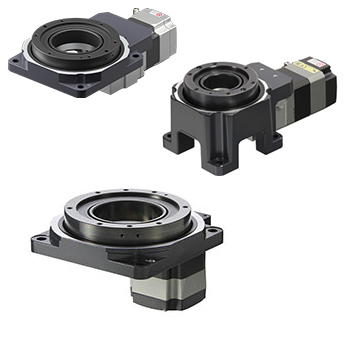
DGII Series with AZ Series motor — horizontal mount, pedestal and vertical mount types
About the Oriental Motor DG Series Hollow Rotary Actuators
The Oriental Motor DG Series (DGII) hollow rotary actuator is an electric rotary actuator that combines a motor, non-backlash gearing and a large cross-roller bearing in one unit. The load mounts directly on the output table, so there is no need to design a belt, pulley and bearing mechanism for an indexing table.
The large-diameter hollow table lets cables and air tubes pass straight through the centre, which simplifies wiring and piping on rotary tables. Built on AZ Series technology, DG actuators include a battery-free absolute sensor, so the table position is kept even when the power is off.
Hollow rotary actuators are a flexible, programmable replacement for mechanical cam indexers and pneumatic rotary actuators, since the index angle and speed can be changed in software. AB Automation supplies DG Series actuators and matching drivers across India and helps with sizing from your table inertia and index time.
Inside a DGII actuator, a small pinion on the motor shaft drives a large ring gear that is built into the output table. Because the reduction happens in a single gear stage, there are fewer parts that can add error, and Oriental Motor uses a proprietary adjustment mechanism to take the backlash out of the mesh on the vertical-motor types. The output table itself rides on a cross-roller bearing (on the 85, 130 and 200 mm frames, and on the updated 60 mm vertical type), so the same component that carries your fixture also takes the thrust and overhung moment loads. In effect you are buying a finished rotary table, not a motor that still needs a mechanism designed around it.
The motor is an αSTEP AZ Series closed loop stepper with a battery-free mechanical absolute sensor (ABZO). Under normal conditions it runs in open loop like a stepper, so it responds quickly on short index moves and holds position without hunting. If the load suddenly exceeds what the motor can follow, the driver switches to closed-loop correction and raises an alarm if the overload continues. For a rotary table this means no gain tuning when you change fixtures or table inertia, and no home sensor, flag or homing routine at start-up.
Because the AZ driver knows the absolute table angle, features that normally need PLC logic are built in: shortest-path (short-cut) rotation to cut cycle time, no-entry zones to keep the table away from a hard stop or a robot, and a round setting with 0.01° per step resolution that is pre-set at the factory. The same AZ drivers used on your linear axes can run the rotary table, so wiring, spares and programming stay common across the machine.
Inside a hollow rotary actuator: gearing, cross-roller bearing and hollow table
A DGII unit has three working parts: the AZ motor with its pinion, a large ring gear machined around the output table, and a cross-roller bearing that supports the table. The motor sits beside the table (vertical, horizontal or on a pedestal), so the centre of the table is left open as a through-hole.
Cross-roller bearings use rollers arranged at alternating right angles between the inner and outer rings. One bearing therefore resists axial load, radial load and tilting moment at the same time, which is why a disc or arm can be bolted straight onto the table with no extra support bearing. The flip side is that the permissible moment and thrust values are real limits — an arm with a heavy tool at its tip loads the bearing far more than the same mass placed near the centre.
Oriental Motor also notes that a small amount of grease can occasionally seep from the actuator. On pharma, food or clean assembly machines, plan a drip tray or include the unit in routine inspection.
Single-stage gearing keeps error sources to a minimum
Vertical-motor types are non-backlash: ±15 arcsec repeatability, 2 arcmin lost motion
Table runout 0.015 mm and parallelism 0.03 mm on the 85 mm frame
Oriental Motor reports lost motion changes only slightly after 10 million cycles in its durability testing
How to size a hollow rotary actuator (selection guide)
Sizing a rotary table is mostly about inertia and index time, not about the mass on the table alone. Work out the load inertia of everything that rotates: a solid disc is J = m × D² / 8, and each fixture or part sitting off-centre adds roughly m × r². Then set the move: the index angle, the time allowed for it and how long the table must dwell.
For a simple triangular speed profile, angular acceleration is 4θ / t² and peak speed is 2θ / t. Acceleration torque is J × α. Add friction and any external torque, apply a safety factor, and compare against the actuator's permissible torque and speed. Example: a 300 mm × 10 mm steel disc (about 5.5 kg) with four 0.5 kg nests at 120 mm radius gives roughly 0.09 kg·m². Indexing 90° in 0.5 s needs about 25 rad/s² and 60 r/min, i.e. about 2.3 N·m before a safety factor — a DG□85R class is the starting point, to be confirmed with Oriental Motor's selection calculation.
Finally check the bearing and the installation: the overhung moment from arms or off-centre tooling, the axial load from pressing or screwing operations, the hollow diameter your cables and tubes need, and which mounting type fits the frame. Send us these numbers and we will run the calculation and confirm the model.
Load inertia (disc, fixtures, parts) and index angle
Index time and dwell time, which set acceleration and speed
Permissible torque and speed of the frame size and gear ratio (18:1 or 36:1)
Moment load and axial load on the table
Hollow diameter needed for cables, air tubes or optics
Motor mount type, AC or DC supply and driver/network type
Replacing belts and pulleys on rotary tables
Many home-built index tables use a stepper or servo, a timing belt, two pulleys, a shaft, a bearing housing and a tensioner. Each part must be designed, sourced, assembled and adjusted, and the belt stretches over time. Oriental Motor's own comparison testing showed the DGII settling without the overshoot and vibration seen on a timing-belt mechanism during acceleration and deceleration.
With a hollow rotary actuator the fixture plate bolts directly to the output table. There is no belt tension to re-set, no pulley alignment and no separate bearing to design, and the hollow centre is free for wiring. For maintenance teams this removes one of the most common causes of drifting index positions.
Hollow rotary actuator vs cam indexer vs pneumatic rotary actuator
A mechanical cam indexer is excellent for a fixed, high-speed, heavy-duty index that never changes, and it keeps running with a simple AC motor. Its limitation is flexibility: the number of stations and the motion profile are cut into the cam, so a product change can mean a new indexer. A pneumatic rotary actuator is cheap and simple but moves between two end stops; intermediate positions need extra hardware and the motion is harder to control smoothly.
A DGII actuator sits between them: any angle, any number of stations, speed and acceleration set in software, and absolute position after power loss. It is the better fit for multi-product lines, machines that change formats, and stations where smooth motion protects the part. For very heavy, very fast single-format lines, a cam indexer or a direct-drive servo table may still be the right tool — we will tell you honestly which fits.
Mounting and routing cables through the hollow table
Choose the mount type from the space you have. The vertical motor type gives the lowest table height but needs a clearance hole in the base plate. The horizontal type (new slimmer design from 2025) needs no clearance hole, and cables can be routed between the legs under the table. The pedestal type also avoids machining the plate, at the cost of extra height. All types can be installed on the floor, a wall or the ceiling.
Cables and air tubes that pass through the hollow bore turn with the table, so allow a service loop and use flexible, robot-rated cable. Keep index moves within the rotation your cabling allows, and use the AZ driver's no-entry area or ±180° round setting so the table never winds up the cables. The cable outlet direction of the AZ motor can also be selected on most types.
Compact 5-phase stepper with hollow flange, driven by CVD 5-phase drivers
Hollow ø5.2 mm / ø10 mm; repeatability ±0.15° / ±0.05°
Specifications are indicative. Contact us for the exact model, availability, lead time and pricing.
Use cases
Pharmaceutical
Vial and blister indexing turret
A turret carries vials or blister cards between filling, checking and capping stations. The DGII indexes to each station with ±15 arcsec repeatability, and the absolute sensor means the turret restarts in position after a stop without a homing run.
No homing after power loss or emergency stop
Packaging
Format-change labelling and packing table
A rotary table presents cartons or bottles to labelling and coding heads. Station count and index angle are changed in the driver for each SKU instead of swapping a cam indexer.
Product changeover by parameter, not by mechanics
Diamond & Gems
Diamond and gemstone inspection turntable
A camera or measuring head inspects a stone as it is rotated in small, precise steps. Smooth stepper motion and 0.01° resolution suit fine angular stepping, and the hollow bore can pass lighting or cables up to the stage.
Fine, repeatable angular steps without backlash
Automotive / Electrical assembly
Screw-fastening and assembly dial
A dial table moves sub-assemblies under screwdrivers and press units. The cross-roller bearing takes the axial force from the tools, and air lines for grippers run through the hollow centre.
Tool reaction force carried by the table bearing
Electronics
Vision inspection rotary stage
Parts are rotated in front of a camera for 360° inspection. Short-cut operation takes the shortest path to each angle and the stepper settles quickly without hunting, keeping images sharp.
Short settling time for faster inspection
Robotics
Cobot peripheral rotary axis
A DGII DC type with the Ethernet mini driver acts as an external turntable for a Universal Robots e-Series or FANUC CRX cobot, turning a fixture so the robot can reach every side. It is configured from the robot's own teach pendant.
Extra axis set up from the cobot pendant
Food & Beverage
Liquid filling carousel with piping through the centre
Product lines feed nozzles on a rotating carousel through the hollow bore, as in Oriental Motor's filling equipment example. This removes rotary joints routed around the side of the table.
Simpler piping and a cleaner machine layout
Laboratory / Medical devices
θ-axis for dispensing and laboratory stages
A ceiling- or wall-mounted DGII provides the rotation axis of a compact dispensing or sample-handling stage, combined with small linear slides for X, Y and Z.
Compact mechanism in place of a larger robot
Indexing and rotary tables
Assembly and inspection stations
Replacing cam indexers
Replacing pneumatic rotary actuators
Robot and vision turntables
Case studies
Semiconductor / Electronic devices
Compact precision dispensing unit using a DGII θ-axis
Challenge
As workpieces became smaller, a general articulated robot was too large for the dispensing system. The drive unit needed to shrink, become more rigid for accurate dispensing, and need less sensor wiring.
Solution
A DGII hollow rotary actuator was ceiling-mounted as the θ-axis carrying a precision X-Y stage, with a small linear slide for the Z direction. The AZ motor's battery-free absolute encoder removed the home and limit sensors, and a network driver cut wiring to a single communication cable.
Result
Oriental Motor reports a smaller dispenser mechanism than the articulated robot layout, non-backlash positioning at ±15 arcsec repeatability, and simplified wiring through the hollow table.
Automated grease application with an OVR robot and DGII rotary axis
Challenge
Grease was applied to ball screws for compact electric cylinders by hand, so quantity and position depended on operator skill and only certain staff could do the job, limiting productivity.
Solution
Oriental Motor built grease application equipment using an OVR 4-axis articulated robot and MRC01 controller, with a DGII hollow rotary actuator and a cleanroom EZS linear slide handling the rotary and linear motion around the robot. All axes used AZ Series motors with battery-free absolute encoders.
Result
Grease quantity became consistent, the cell fitted in an 800 × 1200 × 1600 mm footprint with a cycle time under 100 s, and common AZ wiring and control reduced start-up time.
Genuine Oriental Motor products with warranty, supplied pan-India from Surat, Gujarat.
Selection calculations from your load, speed and positioning requirements.
Wiring, parameter setup, PLC integration and on-site start-up support.
Replacement models for older Oriental Motor products on existing machines.
Frequently asked questions
What is a hollow rotary actuator used for?
It is used to rotate and index a table or fixture accurately. The hollow centre allows cables and tubes to pass through, and the load mounts directly on the output table.
Can a DG Series actuator replace a pneumatic rotary actuator?
Yes. Unlike a pneumatic actuator with fixed end positions, a DG actuator can stop at any angle, change index angles in software and control speed and acceleration smoothly.
What driver does the DG Series use?
DG Series actuators use AZ Series drivers, available in pulse, RS-485 and network types, so they integrate with the same controls as your AZ motors.
What gear ratios are available on DGII hollow rotary actuators?
DGII actuators use a single-stage gear with 18:1 or 36:1 reduction. The higher ratio gives more torque and finer resolution; the lower ratio gives higher table speed.
Does a DGII actuator need a home sensor or a backup battery?
No. The AZ motor has a mechanical absolute sensor that keeps the table position without a battery, even if power fails or the motor cable is unplugged, so no home sensor or homing routine is needed.
Can I use a DGII table with my existing servo motor?
Yes. The DGN130 and DGN200 hollow rotary gearheads use the same hollow table structure without a motor and couple to servo motors from other manufacturers. A DGM200R version with Oriental Motor's AZX servo motor is also available.
Can the actuator be mounted on a wall or upside down?
Yes. Vertical, horizontal and pedestal types can all be installed horizontally, on a wall or on the ceiling. Check moment and axial load limits for the orientation, and allow for the small grease seepage Oriental Motor notes.
Is there a smaller hollow rotary actuator than the 60 mm DGII?
For very light θ-axes, the DH Series combines a 5-phase stepper motor with a hollow flange in 28 mm and 42 mm frames (ø5.2 mm and ø10 mm hollow), driven by CVD 5-phase drivers.