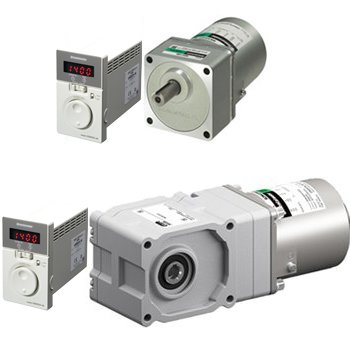
US2 Series packages: parallel shaft and right-angle gear motors with the dial-set speed controller
About the Oriental Motor US2 / DSC Speed Control Motors
Oriental Motor US2 and DSC series are AC speed control motor and controller packages for applications that need adjustable speed from a single-phase supply. A tachogenerator on the motor feeds speed back to the controller, so speed is held steady as the load changes.
The US2 series is the simple choice, with speed set on a front dial and forward/reverse inputs, while the DSC series adds external speed setting (potentiometer or 0–10 VDC), preset speeds, instant stop/reverse and a brake type for vertical loads. Both run on single-phase 220/230 VAC and pair with Oriental Motor gearheads for low-speed, high-torque drives.
For conveyors, feeders and mixers that only need a simple, reliable variable speed, these packages are often more economical than an AC motor with a VFD. AB Automation supplies US2 and DSC motors with matching gearheads across India.
An Oriental Motor AC speed control motor is a single-phase, capacitor-run induction motor with a small tachogenerator fitted at the rear of the shaft. The tachogenerator produces 12 cycles of AC voltage per revolution, and the speed controller compares that signal with the speed you set. The controller uses a TRIAC to switch part of every half-cycle of the mains supply to the motor (phase control). If the load increases and the motor slows down, the controller raises the voltage; if the motor runs fast, it lowers the voltage. Because the loop is closed, the motor can run steadily in the low-speed region where an open-loop induction motor would stall or hunt.
Phase control switches only once per half-cycle, so the controller is simpler than an inverter. There is no DC bus, no large electrolytic capacitor and very little switching noise. That is why a US2 or DSC controller is compact, needs few noise-suppression parts, and gives a load speed regulation of about ±1% (Oriental Motor reference value, from no load up to permissible torque at 1000 r/min). Oriental Motor's reference figure for a general-purpose inverter driving an induction motor without feedback is roughly −6% to −10%.
The motor, gearhead and controller are sold as a matched package, and the controller is built for that motor. You do not need to enter motor parameters, choose a braking resistor or tune anything. On a single-phase 230 VAC, 50 Hz supply, as used in Indian plants, the motor shaft speed can be set from 90 to 1400 r/min. The pre-assembled gearhead then reduces that to the conveyor, feeder or mixer speed you need, with ratios from 5:1 to 360:1.
Key features
Single phase 220/230 VAC, 50/60 Hz
Output 6 – 90 W, frame sizes 60 – 90 mm
Speed range 90 – 1400 r/min (50 Hz)
US2: simple dial setting; DSC: external speed signal & presets
Matching parallel-shaft gearheads
How tachogenerator feedback holds the speed steady
The speed of an induction motor depends on the supply frequency and the slip. Lowering the voltage increases the slip, which reduces the speed. On its own this only works over a narrow band: as the voltage drops, the motor moves into the unstable part of its speed-torque curve, and a small change in load can make it stall or race. This is why a plain voltage regulator on a standard motor gives poor results.
Oriental Motor speed control motors add a magnet-and-coil tachogenerator on the motor shaft. It generates 12 cycles per revolution, so the controller always knows the actual speed. Every half-cycle, the controller adjusts the TRIAC firing angle to close the gap between the set speed and the actual speed. The result is stable running from 90 r/min upwards, speed that barely changes when a box lands on the conveyor, and an alarm and motor shut-off if the motor locks or overheats.
There is one limit to keep in mind. An induction motor produces less continuous torque as the speed falls, and each motor has a published 'safe-operation line' for continuous duty. For slow output speeds, use a higher gear ratio instead of running the motor near 90 r/min for long periods. The gearhead multiplies torque and keeps the motor in its comfortable range.
Tachogenerator: 12 AC cycles per motor revolution
Phase control with TRIAC switching: low electrical noise, no DC bus
Load speed regulation about ±1% (reference value)
Check the safe-operation line when running continuously at low motor speed
US2 vs DSC — which package should you choose?
Both series use the same SCM speed control motors, the same output range (6–90 W) and the same high-strength gearheads. The difference is the controller. The US2 is aimed at operators who want to walk up to the machine and set a speed. It has a large digital display and a single dial: turn to change the speed, press to confirm. A switch on the front starts, stops and reverses the motor. The capacitor is built into the controller, and the only external signals are forward and reverse inputs. That makes it quick to wire on a standalone conveyor, feeder or test rig.
The DSC is the better choice when the motor has to be controlled from a PLC or panel. Its slim DIN-rail controller accepts an external potentiometer or a 0–5 / 0–10 VDC speed signal. It stores four preset speeds that you select with two inputs, gives alarm and speed pulse outputs, and can run up to 20 motors in parallel from one speed command with a per-motor offset. It also offers instantaneous stop, instantaneous reversing of a standard induction motor, and an electromagnetic brake version with deceleration control for inclined or vertical loads. Note that the DSC controller needs a separate 24 VDC supply for its control circuit.
Rule of thumb: use US2 for simple, operator-set speed on a single machine. Use DSC when you need PLC control, multiple speeds, several motors synchronised from one potentiometer, or a load that can drive the motor, such as an incline, a lift or a heavy flywheel.
US2: dial setting and display on the controller, run/stop/reverse switch, built-in capacitor, FWD/REV inputs
DSC: keypad, external potentiometer or 0–10 VDC; 4 speeds; up to 20 motors in parallel; alarm and speed outputs
DSC only: instantaneous stop, instantaneous reversing, electromagnetic brake type for vertical loads
Both: 6–90 W, 90–1400 r/min at 50 Hz, ±1% load speed regulation, same gearheads
Selection guide: output power and gear ratio for a conveyor
Start with the belt speed and the roller diameter. The gearhead output speed is the belt speed divided by the roller circumference. For example, 12 m/min on a 100 mm drive roller needs about 12 ÷ (π × 0.1) ≈ 38 r/min. Because the motor speed can be varied, you do not need an exact ratio. Pick a ratio that puts your normal operating speed in the middle of the adjustable range, with headroom above and below. At 50 Hz the motor runs from 90 to 1400 r/min, so a 1:18 gearhead gives roughly 5–78 r/min at the output. Running at about 38 r/min puts the motor near 690 r/min, well inside that range.
Next, calculate the load torque at the roller: belt pull (friction of the load and belt on the bed, plus any incline component) multiplied by the roller radius. Add a safety factor, commonly 1.5 to 2, for starting and load variation. Then choose the smallest output whose permissible gearhead torque at your ratio covers it. Remember that the permissible torque of a gearhead is capped at high ratios: 40 N·m for the 90 W parallel shaft type and 53.9 N·m for the 90 W right-angle type. Also check the overhung load if you drive the roller through a chain or belt. The 90 W parallel shaft gearhead allows 500 N radial load at 10 mm from the shaft end.
Finally, look at the duty. Continuous low-speed running should stay under the motor's safe-operation line. Frequent reversing points to the DSC's instantaneous reversing function. Inclines, lifts and the risk of the load running back during a power cut point to the DSC electromagnetic brake type. If the numbers push you past 90 W, or you need a much wider speed range, look at a brushless motor instead.
Output speed (r/min) = belt speed (m/min) ÷ (π × roller diameter in m)
Choose a ratio so that normal speed sits mid-range (motor about 500–900 r/min at 50 Hz)
Load torque × safety factor 1.5–2 ≤ gearhead permissible torque at that ratio
Check radial load for chain or belt drives; consider a right-angle hollow shaft to mount directly on the roller shaft
Use the brake type (DSC) for inclines, lifts and vertical axes
Speed control motor or AC motor with a VFD?
A VFD changes the supply frequency to a three-phase motor. It gives a wide speed range, is the standard choice above a few hundred watts, and offers network communication, sensorless vector control and energy savings on fans and pumps. For a small single-phase drive on a machine, though, it brings extra work: you need a three-phase inverter-duty motor, drive parameter setup, EMC filtering and cable screening. Without feedback, the speed also drops as the load rises.
A US2 or DSC package runs on the single-phase supply the machine already has. It holds speed within about ±1% because of the tachogenerator loop, and it comes as a matched set with nothing to tune. Up to 90 W this is usually the simpler and more economical answer. Above that, or when you need very high speed, regenerative braking or fieldbus control, a VFD, or a brushless motor paired with an inverter, is the better tool.
When to upgrade from an AC speed control motor to brushless
AC speed control motors are robust and inexpensive, but they are still induction motors. Their speed range is roughly 15:1 (90–1400 r/min at 50 Hz), their efficiency is lower than a permanent-magnet motor, and continuous torque falls off at low speed. Oriental Motor's brushless motors, such as the BMU Series, offer a speed range of 80–4000 r/min, speed regulation of about ±0.2%, flat torque across the range, and shorter, lighter motors at the same output.
Consider moving to brushless when you need a wide speed range on one machine, such as a coating line that runs both slow and fast recipes. The same applies when two belts must match speed closely (grip and side conveyors for labelling), when the motor runs 24×7 and energy cost matters, when the motor case runs hot at low speed, or when you need more than 90 W in a compact frame. For simple single-speed-band duty, the AC speed control package remains the lower-cost choice.
Speed range: AC speed control about 90–1400 r/min at 50 Hz; BMU brushless 80–4000 r/min
Speed regulation: about ±1% (AC speed control) vs ±0.2% (BMU)
Brushless for tight speed matching, wide speed ranges, energy saving and outputs above 90 W
Specifications
Output power
6 W, 15 W, 25 W, 40 W, 60 W, 90 W
Frame sizes
60 mm (6 W), 70 mm (15 W), 80 mm (25 W), 90 mm sq. (40 / 60 / 90 W)
Power supply
Single-phase 220/230 VAC, 50/60 Hz (single-phase 110/115 VAC versions also exist). The DSC controller also needs a 24 VDC supply for its control circuit
±1% (reference value, from no load to permissible torque at 1000 r/min)
Gear ratios
5:1 to 360:1. At 60 Hz, gearhead output is about 0.25 – 320 r/min
Gearhead permissible torque
Parallel shaft: 0.23 – 6 N·m (6 W) up to 3.3 – 40 N·m (90 W). Right-angle: up to 53.9 N·m (90 W)
Gearhead types
Parallel shaft, right-angle hollow shaft and right-angle solid shaft (25 / 40 / 90 W), or round shaft with no gearhead
Operating ambient
Motor (220/230 VAC type): −10 to +40 °C; controller: 0 to +50 °C; 85% RH max, non-condensing
Controller protection / standards
IP20 controller. US2: UL/CSA recognised, CE marked, CCC
Product line-up
Type
Description
Key ratings
US2 Series package (SCM motor + US2D controller)
Speed is set and shown on the front of the controller: turn the dial to change speed in 1 r/min steps, press it to confirm. A switch on the controller starts, stops and reverses the motor. External FWD/REV inputs, capacitor built into the controller, adjustable acceleration/deceleration time, and alarms for overheat, motor lock and poor connection
6 – 90 W, 90 – 1400 r/min at 50 Hz
DSC Series package (SCM motor + DSCD controller)
Compact DIN-rail controller (35 mm wide, 90 mm deep). Speed can be set from the keypad, an external potentiometer or 0–5 / 0–10 VDC. Stores 4 preset speeds, runs up to 20 motors in parallel, and offers instantaneous stop, instantaneous reversing, alarm and speed outputs and data lock
6 – 90 W, 90 – 1400 r/min at 50 Hz
DSC Series electromagnetic brake type
A power-off brake holds the load during a power failure or at standstill. Deceleration control applies a braking current, so the motor holds the set speed on vertical and gravitational loads without a regeneration unit
6 – 90 W, 300 – 1600 r/min (60 Hz)
6 W / 15 W sizes (60 mm, 70 mm)
For light conveyors, small feeders, sample turntables and machine auxiliaries. Available with parallel shaft gearhead or round shaft
Motor only, for belt-and-pulley drives, fans or your own reduction
50 mN·m (6 W) to 730 mN·m (90 W) at the motor shaft
Specifications are indicative. Contact us for the exact model, availability, lead time and pricing.
Use cases
Packaging
Variable-speed belt conveyor on a packaging line
A 25 W or 40 W parallel shaft gear motor drives the conveyor head roller. The operator sets the belt speed on a US2 controller to match the upstream filler. The tachogenerator loop holds the speed as cartons of different weights come onto the belt.
Belt speed matched to the filler without a separate VFD
Textile
Vibratory and belt feeders on textile machine auxiliaries
Yarn and fabric-handling auxiliaries in Surat's textile units often need a feed rate that can be trimmed to the main machine. A DSC controller takes a 0–10 VDC speed reference from the machine PLC, so the feeder speed follows the line speed automatically.
Feed rate follows the main machine through an analogue signal
Pharmaceutical
Low-speed stirrer for liquid batching
A 60 W or 90 W gear motor with a high ratio turns a mixing paddle. The speed is fixed for each recipe using the DSC's four preset speeds, and the alarm output stops the batch if the paddle locks in a thick mixture.
Repeatable recipe speeds and a lock alarm to the PLC
Food processing
Inclined bucket or tray elevator
A DSC electromagnetic brake type drives an inclined tray conveyor. Deceleration control keeps the descending side at the set speed, and the power-off brake holds the trays in place if the supply fails.
No run-back on power failure, and no regeneration unit needed
Diamond and jewellery processing
Multi-lane conveyor running from one speed pot
Several small 6 W or 15 W conveyors or turntables in a sorting or polishing area run in parallel from a single external potentiometer on DSC controllers. Any lane that runs slightly fast or slow is trimmed with the controller offset parameter.
Up to 20 motors adjusted together from one knob
Printing
Web and label unwind auxiliary drive
A right-angle hollow shaft gear motor mounts directly on an auxiliary roller shaft, so no coupling or bracket is needed. The operator sets the roller speed on the US2 dial during changeovers.
Compact direct mounting with simple dial speed setting
Testing and R&D
Endurance and life-test rig
Test benches that rotate a component at a set speed for thousands of cycles use a US2 package for its clear speed display. The accel/decel setting avoids shock loads, and alarms for overheat or lock stop the test safely.
Displayed, repeatable test speed with built-in protection
Automotive components
Reversing transfer conveyor
A shuttle conveyor that sends parts left or right uses the DSC's instantaneous bi-directional operation with a standard induction motor. This avoids the time rating of a reversible motor, and the PLC switches direction through the FWD/REV inputs.
Frequent reversing with a continuously rated motor
Conveyors and feeders
Mixers and agitators
Printing and textile auxiliaries
Food processing equipment
Test rigs
Case studies
Beverage / labelling
Grip (side) conveyor: eliminating speed difference between two belts
Challenge
Two belts, each driven by a three-phase induction motor on an inverter, gripped bottles for printing and labelling. Small speed differences between the belts made the bottles rotate, which caused uneven printing and misaligned labels, and fine speed trimming on the inverters was difficult.
Solution
Oriental Motor proposed its BMU Series brushless motors with digital speed setting in 1 r/min steps. This is the typical upgrade path when an application outgrows open-loop inverter control and needs tighter speed matching than an AC speed control motor provides.
Result
Oriental Motor quotes load speed regulation of ±0.2% for the BMU, against a reference value of −15% for an induction motor on an inverter, so the two belts can be matched and label quality improves.
Bottle printing line: stabilising conveyor speed under changing load
Challenge
A beverage maker's grip conveyor used two inverter-driven three-phase induction motors. Because V/f inverter control does not measure actual speed, the belts slowed differently as load changed, shifting print positions from bottle to bottle.
Solution
The motors were replaced with BMU Series brushless motors, which compare the set speed with the actual speed and correct the voltage continuously. Operators set and read the speed on the driver dial.
Result
Oriental Motor reports speed regulation of ±0.2% versus about −10% for the inverter-driven motors. The 120 W BMU is about 84.6 mm shorter than the 90 W induction motor it replaced and uses roughly 26% less power.
Double-row belt conveyor: direct drive with a right-angle hollow shaft gearhead
Challenge
A slim two-row carton conveyor was driven by an induction motor mounted underneath through a timing belt and pulleys. The drive stuck out from the side and bottom of the conveyor and needed many extra parts to assemble.
Solution
A compact motor with a right-angle hollow shaft hypoid (JH) gearhead was mounted between the two rows, with the drive rollers fixed to both ends of the load shaft. The same mounting idea applies to the 25, 40 and 90 W right-angle hollow shaft types of the US2 and DSC Series.
Result
The side and bottom protrusions were removed. Timing pulleys, the belt, the safety cover and mounting plates were no longer needed, which cut design, assembly and parts-management time.
Genuine Oriental Motor products with warranty, supplied pan-India from Surat, Gujarat.
Selection calculations from your load, speed and positioning requirements.
Wiring, parameter setup, PLC integration and on-site start-up support.
Replacement models for older Oriental Motor products on existing machines.
Frequently asked questions
Do I need a VFD with an Oriental Motor speed control motor?
No. The US2 and DSC packages include their own speed controller, so no separate VFD is needed.
What is the difference between US2 and DSC?
US2 is the simpler package with speed set on the controller dial. DSC adds external speed setting, preset speeds, instant stop/reverse and a brake type. Both are single-phase AC speed control motors.
When should I choose a brushless motor instead?
Choose a BLDC motor (BMU, BLE2) when you need a wider speed range, higher efficiency or more precise speed regulation than an AC speed control motor provides.
What speed range will I get on a 230 V, 50 Hz supply in India?
At 50 Hz the motor shaft speed can be set from 90 to 1400 r/min (90 to 1600 r/min at 60 Hz). The gearhead ratio, from 5:1 to 360:1, sets the final output speed range. For example, a 1:18 gearhead gives roughly 5 to 78 r/min at the output shaft.
Can a speed control motor be used on an incline or vertical lift?
Yes, with the DSC Series electromagnetic brake type. Its deceleration control applies a braking current to hold the set speed when the load tries to drive the motor, and the power-off brake holds the load if the supply fails. Permissible torque for vertical and gravitational duty is lower and is specified per gear ratio, so share your load details for sizing.
Can the speed be set from a PLC?
The DSC controller accepts an external potentiometer or a 0–5 / 0–10 VDC analogue signal, has two inputs to select one of four preset speeds, and provides alarm and speed pulse outputs. The US2 is set on its front dial and accepts only forward and reverse run signals, so choose DSC for PLC-controlled speed.
How far can the controller be from the motor?
The motor and speed controller connect with a plug-in cable and can be up to 10 m apart using Oriental Motor connection or extension cables. Use the flexible cable version where the cable moves.
Can I run several conveyors at the same speed from one knob?
With the DSC Series, one external speed potentiometer can drive up to 20 motors in parallel. Small speed differences between motors are trimmed with each controller's external speed command offset parameter.