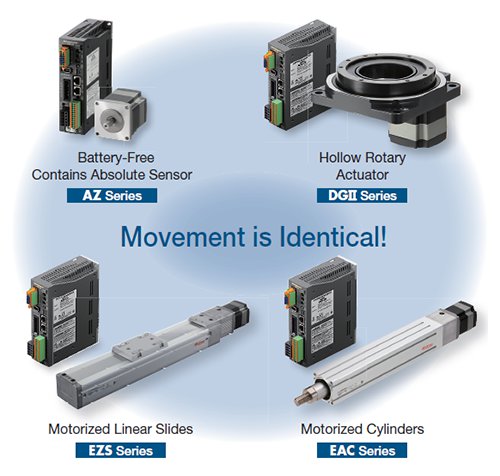
The AZ family: motor and driver, plus DGII, EZS and EAC actuators driven by the same AZD drivers
About the Oriental Motor AZ Series Closed-Loop Stepper
The Oriental Motor AZ Series (AlphaStep) is a closed loop stepper motor and driver package that combines the simplicity of a stepper with the reliability of feedback. A built-in ABZO mechanical absolute sensor tracks the shaft position at all times, so the motor never loses synchronism silently — if it is overloaded, the driver corrects position or raises an alarm instead of missing steps.
Because the ABZO sensor is mechanical and battery-free, the absolute position is retained even with the power off. That removes the homing sequence after every power cycle, removes the home sensor from many machines, and removes battery maintenance that servo systems with absolute encoders need.
Unlike a servo, the AZ Series needs no gain tuning and does not hunt at standstill, which makes it a strong choice for indexing tables, pick-and-place axes, conveyors and any short, fast positioning move. As an authorised Oriental Motor distributor, AB Automation supplies AZ motors, drivers, geared types and linear/rotary actuators built on AZ across India, and helps you choose the right frame size and driver type.
The AZ Series uses what Oriental Motor calls a hybrid control system. Under normal load the driver runs the motor like a conventional stepper, in step with the command, so it keeps the fast response and firm holding of a stepper. The ABZO sensor watches the rotor all the time. If the position error reaches about ±1.8° (for example during a sudden load change or a very aggressive acceleration), the driver switches to closed-loop mode and energises the windings according to the actual rotor position to pull the load back into place. Once the error is corrected, it goes back to open-loop running. If the overload continues, the driver raises an alarm instead of carrying on with a lost position.
The ABZO sensor is a compact mechanical multi-turn absolute sensor. It is built from a set of small gears, and the driver reads position by recognising the angle of each gear, so no battery is needed to remember the count. From the home position it can track ±900 motor revolutions (1,800 revolutions in total); on the 20 mm and 28 mm frames the range is ±450 revolutions. Because the position lives inside the motor, it survives a power cut and even a disconnected motor cable. The one thing to remember is that the home position has to be set again if the motor itself is replaced.
The AZ motor is only half of the system. It always runs with an AZD driver, and the same driver family also runs the AZ-based EZS linear slides, EAC electric cylinders, DR/DRS2 compact cylinders, DGII hollow rotary actuators and EH electric grippers. For a machine builder this means one set of software (MEXE02), one wiring approach and one spare-parts list covers rotary axes, linear axes and grippers. Oriental Motor states a typical stopping accuracy of ±0.05° at no load, which is in the same class as an AC servo, and a standard resolution setting of 1,000 pulses per revolution (0.36° per pulse) that can be changed in the driver.
Key features
DC input (24/48 VDC) and AC input (100–120 / 200–240 VAC) types
Standard motors up to 4 N·m; geared types up to 110 N·m
Absolute position retained with power off (battery-free ABZO sensor)
Pulse, RS-485 (Modbus), EtherCAT and other network drivers
No gain tuning, no hunting at standstill
Geared, brake and electromagnetic-brake variants
How the ABZO sensor and hybrid control work
A conventional stepper counts pulses and assumes the rotor followed them. If the load jams or the acceleration is too steep, the rotor slips, the count is wrong and nothing tells the PLC. The AZ Series closes that gap in two ways: the ABZO sensor always knows the true shaft position, and the driver uses that information to correct errors itself.
In normal running the AZ behaves like an open-loop stepper, so it responds instantly to short moves and holds position at standstill without the small back-and-forth hunting a servo can show on a flexible belt or low-rigidity mechanism. When the deviation between command and actual position reaches about ±1.8°, the driver switches to closed-loop mode and drives the windings to generate torque based on the real rotor position, bringing the load back in line. A continuous overload produces an alarm output, and an END signal confirms each completed move.
Because the ABZO sensor is mechanical, it keeps the absolute position without a battery or power, which is the main practical difference from servo systems that use battery-backed multi-turn encoders.
No home or limit sensors needed for return-to-home in most machines
Home is set with a switch on the driver, MEXE02 software or an input signal
Position survives power loss and a disconnected motor cable
Set home again after replacing a motor
How to select an AZ Series motor and driver (selection guide)
Start from the mechanism, not the catalogue. Work out the load inertia, the required move distance and time, and any thrust or gravity load, then use Oriental Motor's sizing tools or send the data to us. As a rule of thumb from Oriental Motor, an open-loop stepper handles roughly 10 times its rotor inertia, a closed-loop stepper around 30 times, and a servo about 100 times. If your inertia ratio is high, a geared AZ motor is often the answer because the gear ratio divides the reflected inertia and multiplies torque.
Next pick the supply. DC input (24/48 VDC) suits compact machines, battery-powered AGVs and panels with an SMPS already fitted, and it gives access to the smallest frames, mini drivers and multi-axis drivers. AC input (100–120 VAC or 200–240 VAC) gives the larger 85/90 mm frames and more high-speed torque, and plugs straight into a typical Indian 230 VAC control panel.
Finally choose how the PLC will talk to the driver. This choice matters more than the motor for commissioning time.
Pulse input: use with a PLC positioning module or motion controller that already generates pulses (line driver up to 1 MHz, open collector up to 250 kHz)
Pulse input with RS-485: same pulse control plus Modbus monitoring of position, speed, load factor, temperature and alarms
Built-in controller: store up to 256 moves in the driver and trigger them by I/O or Modbus RTU; up to 31 drivers on one RS-485 line
EtherCAT, EtherNet/IP or PROFINET: direct connection to the machine network, no pulse module needed
Mini drivers and 2–4 axis drivers: DC input only, for tight panels or mounting near the motor
Add a brake motor for vertical axes so the load cannot drop on power loss
AZ Series vs conventional stepper vs servo — which should you choose?
A conventional open-loop stepper such as the PKP Series is the most economical option when the load is steady, the move profile is conservative and a missed step would only cost a re-home. It needs no feedback and no tuning, but it cannot tell you if it has lost position, and it typically has to be derated to keep temperature in check.
An AC servo is the right tool for continuous high-speed motion, very high inertia ratios and applications that need strong torque across a wide speed range. It needs tuning, and a multi-turn absolute servo encoder usually depends on a backup battery.
The AZ Series sits between the two. It gives the stepper's strong low-speed torque, quick short moves and hunting-free standstill, adds feedback, overload alarms and battery-free absolute position, and does not need gain tuning. Oriental Motor's own comparison on an index table showed the AZ positioning faster for short moves, while the servo was quicker once the travel went beyond roughly four motor revolutions. That is a useful rule when you are deciding for an indexing table, a pick-and-place axis or a feeder.
Short, frequent moves on belts, cams or index tables: AZ Series
Steady light loads and lowest cost: open-loop PKP + CVD
Long, fast continuous moves or very high inertia: AC servo
AC input or DC input — what changes?
The motors are not interchangeable between the two families: an AC input AZ motor runs with an AC input AZD driver, and a DC input motor with a DC input driver. Both families use the same ABZO sensor, the same MEXE02 software and very similar operating functions, so the choice is mainly about power, size and panel design.
Choose DC input when the machine is compact, runs from 24 V or 48 V, or is battery powered (AGVs, mobile robots). You also get the 20 mm and 28 mm frames, the mini drivers that fit near the motor, and 2–4 axis EtherCAT drivers. Choose AC input for larger frames up to 85/90 mm, higher torque at speed and when you want to run directly from single-phase or three-phase mains without a separate DC supply. AC input drivers also offer a Safe Torque Off (STO) function for machine safety circuits.
Setting up and commissioning in an Indian plant
Most AZ installations we see in Gujarat are on machines that already have a Mitsubishi, Siemens, Omron or Delta PLC. With a pulse-input driver the AZ drops into an existing positioning module as a replacement for a stepper or servo drive. With a built-in controller driver you can store the moves in the driver and let the PLC trigger them over I/O or Modbus RTU, which suits small special-purpose machines where adding a motion module is not worth the cost.
Oriental Motor's MEXE02 software is a free download and lets you set parameters, test moves, and watch waveforms, load factor and temperature. For machines that restart after every shift change or power cut, as is common in textile and packaging units running on unstable supply, set the home position once with the switch on the driver and the machine can resume from where it stopped without a homing run.
Specifications
Control method
Hybrid: open-loop in normal running, automatic closed-loop correction on overload; no gain tuning
Absolute range
±900 revolutions (1,800 rev) from home; ±450 revolutions on 20 mm and 28 mm frames
Frame sizes
DC input: 20, 28, 35 (geared), 42, 60 mm; AC input: 42, 60, 85/90 mm
Max. holding torque (standard motor)
DC input: 0.02 – 2 N·m; AC input: 0.3 – 4 N·m
Max. holding torque (geared types)
Up to 40 N·m (DC input, 60 mm) and up to 110 N·m (AC input, 90 mm)
Compact DC drivers for mounting near the motor: AZD-KRED (EtherCAT), AZD-KREP (EtherNet/IP), AZD-KRPN (PROFINET), AZD-KR2D (RS-485), AZD-KRX (pulse + RS-485), AZD-KREN (Modbus TCP/UDP)
24/48 VDC
Multi-axis EtherCAT drivers
AZD2B-KED (2-axis), AZD3A-KED (3-axis), AZD4A-KED and slim AZD4C-KED (4-axis) controller/drivers
24/48 VDC, up to 4 axes per unit
Specifications are indicative. Contact us for the exact model, availability, lead time and pricing.
Use cases
Pharmaceutical
Indexing table on a pharma blister or cartoning line
An AZ motor, often with a DGII hollow rotary actuator or a geared motor, indexes the product turret in short, fast steps. The built-in controller stores the index moves, and the ABZO sensor keeps position through power interruptions.
No re-homing after a power cut or E-stop
Packaging
Film feed and cut-to-length on packaging machines
The AZ drives a feed roller or a knife axis where the load changes with film tension. The motor runs open-loop for crisp starts and stops but corrects position automatically if the film snags.
Consistent cut length without gain tuning
Textile
Take-up and positioning axes on textile and embroidery machines
Belt-driven axes with low rigidity are a natural fit because the AZ holds its stop position without hunting. Overload alarms tell the operator when a jam happens instead of silently producing bad fabric.
Jams flagged instantly, not discovered at inspection
Diamond & gems
Stone positioning and inspection stages in diamond processing
Small DC-input AZ motors with PN or harmonic gears position stones under cameras and lasers. The ±0.05° typical stopping accuracy and zero-backlash gear options suit fine angular indexing.
Fine, repeatable angular indexing in a compact package
Electronics
Pick-and-place gantry for electronics assembly
X-Y-Z axes built from AZ motors or EZS linear slides share one driver family, with EtherCAT or multi-axis drivers keeping panel space small. Short moves complete quickly because there is no settling time from servo tuning.
Shorter cycle time on short point-to-point moves
Warehousing & logistics
Automated storage and sorting conveyors
AZ motors with electromagnetic brakes drive shuttle and lifting axes in compact warehouses. The absolute sensor removes home and limit sensors and lets the system restart immediately after an emergency stop.
Faster start-up and recovery with fewer sensors
Material handling
Drive wheels and lifts on AGVs and mobile robots
DC-input AZ motors with mini drivers run from 24 V or 48 V batteries. The mini driver mounts near the motor and connects over EtherCAT, EtherNet/IP or RS-485.
Lighter wiring and lower power draw on battery
Medical & laboratory
Sample handling in laboratory and diagnostic equipment
Compact AZ motors and mini drivers move pipettes, trays and doors in analysers where space is tight and safety interlocks cut power often. Position is kept through each interlock event.
No homing sequence each time the door is opened
Indexing and rotary tables
Pick-and-place and gantry axes
Packaging, labelling and filling machines
Textile and embroidery machines
Inspection and vision stages
Case studies
General machinery
Cutting equipment reset time after an emergency stop
Challenge
A machine relied on limit and home sensors to re-find its origin after every emergency stop. Searching for the sensors was slow, especially from positions far from home, and an incorrect return-to-home risked the load hitting the machine.
Solution
Oriental Motor proposed AZ Series motors and AZ-equipped actuators. The ABZO sensor retains position through a power cut or a disconnected motor cable, and built-in controller drivers can resume positioning without a homing run.
Result
Operation can restart immediately from the stopped position after an E-stop or power outage, and the external home and limit sensors are no longer needed.
Adding automated axes to a food packaging machine without a bigger panel
Challenge
A packaging machine builder wanted to automate more manual steps, but every extra axis needed space in the control cabinet, and the existing servo drivers were too large to add more.
Solution
AZ Series motors with network-compatible mini drivers (EtherCAT, EtherNet/IP, PROFINET and other versions) measuring W69 × D56 × H30 mm, small enough to mount near the motors.
Result
Oriental Motor reports about a 63% volume reduction versus its conventional DC single-axis network driver (110 g vs 180 g), allowing more automated axes in the same machine footprint.
Smaller genetic testing equipment with less downtime
Challenge
Stand-alone genetic testing equipment had to stay compact, but conventional drivers took too much cabinet space. A safety interlock cut power whenever the door opened, and each axis then needed several minutes of return-to-home.
Solution
AZ Series DC motors with RS-485 mini drivers (W47 × D53 × H24 mm, 56 g) and the battery-free absolute sensor to retain position through each power interruption.
Result
The mini driver is about 75% smaller in volume than the conventional single-axis driver, and the machine restarts from its current position without initialisation, reducing downtime.
Stable, compact conveying in a small automated warehouse
Challenge
A small automated warehouse had very little space for the conveying system and needed short initialisation times at start-up and after emergency stops.
Solution
AZ Series motors, including electromagnetic brake types, for the belt-driven and lifting axes, combined with BMU brushless motors for load feed. The AZ ran the low-rigidity timing belt synchronously without gain adjustment.
Result
Return-to-home works without home or limit sensors, initialisation time is shorter, home accuracy is no longer affected by sensor variation, and the brake prevents falling on power loss.
Genuine Oriental Motor products with warranty, supplied pan-India from Surat, Gujarat.
Selection calculations from your load, speed and positioning requirements.
Wiring, parameter setup, PLC integration and on-site start-up support.
Replacement models for older Oriental Motor products on existing machines.
Frequently asked questions
What is the difference between a closed loop stepper motor and a servo motor?
A closed loop stepper like the Oriental Motor AZ Series uses position feedback to prevent missed steps but keeps the stepper’s high torque at low speed, zero hunting at standstill and no tuning. A servo is better for continuous high-speed motion; the AZ Series is usually simpler and more economical for short, frequent positioning moves.
Does the AZ Series need a battery to keep its absolute position?
No. The ABZO sensor is a mechanical multi-turn absolute sensor, so it keeps the position without a battery, even when the power is off.
Which networks do AZ Series drivers support?
AZ Series drivers are available with pulse input, built-in controller (RS-485/Modbus RTU) and industrial network types such as EtherCAT. Tell us your PLC or controller and we will recommend the matching driver.
Do you supply the AZ Series across India?
Yes. AB Automation is an authorised Oriental Motor distributor based in Surat, Gujarat, supplying AZ Series motors, drivers and actuators pan-India with selection and start-up support.
How many revolutions can the ABZO sensor track?
The ABZO sensor keeps absolute position over ±900 motor revolutions (1,800 in total) from the home position. On the 20 mm and 28 mm frame motors the range is ±450 revolutions. For long-travel axes, a gear or pulley ratio is usually chosen so the full stroke stays within this range.
Can I use an AC input AZ motor with a DC input driver?
No. AC input AZ motors must be paired with AC input AZD drivers, and DC input motors with DC input (AZD-K) drivers. Tell us your supply and we will match the correct motor and driver pair.
Do I need to re-home the AZ Series after replacing the motor?
Yes. The position is stored in the ABZO sensor inside the motor, so a new motor needs its home position set once, using the switch on the driver, MEXE02 software or an external input. If only the driver is replaced, the position data stays in the motor, but the driver parameters must be copied across with MEXE02.
Can the AZ Series work with a Mitsubishi PLC?
Yes. Pulse-input AZD drivers work with Mitsubishi positioning modules and PLC pulse outputs, and built-in controller drivers can be commanded over Modbus RTU. Oriental Motor also lists SSCNET III/H and CC-Link support through network converters or specific drivers, so check with us for your exact PLC model.