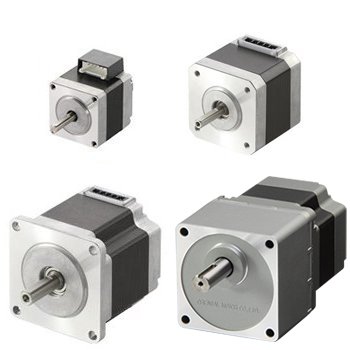
PKP Series stepper motors in 28, 42, 56.4 and 60 mm frames
About the Oriental Motor PKP Series Stepper Motors
The Oriental Motor PKP Series is a range of 2-phase hybrid stepper motors designed for high torque and low vibration. With a 1.8° standard step angle (0.9° on high-resolution types), PKP motors position accurately in open loop — no feedback device or tuning required — which keeps machine cost and wiring simple.
PKP motors cover the common frame sizes machine builders use, from compact 20 mm and 28 mm motors up to 42 mm (NEMA 17), 56.4 mm (NEMA 23), 60 mm and 85 mm (NEMA 34) frames. Geared types, electromagnetic-brake types and motors with a built-in encoder are available when you need more torque, holding or position verification.
Pair a PKP motor with an Oriental Motor CVD driver for a complete, matched stepper package. AB Automation supplies genuine PKP stepper motors across India and helps you size the motor from your load, speed and acceleration so you do not over- or under-specify it.
Every PKP motor is a hybrid stepper. The rotor carries an axially magnetised permanent magnet sandwiched between two toothed rotor cups, one acting as a north pole and the other as a south pole, with the cups offset by half a tooth pitch. The stator is wound like a variable-reluctance motor and is also toothed. Standard PKP rotors have 50 teeth, which gives the familiar 1.8° step (200 steps per revolution); high-resolution types double this to 100 teeth for a 0.9° step (400 steps per revolution). Because the position is set by this fine mechanical tooth geometry, a PKP motor stops accurately without any feedback device, and the step error does not accumulate from one move to the next.
What separates PKP from the older PK Series and from generic imported steppers is torque density. Oriental Motor revised the magnetic circuit and structure so that a PKP motor produces roughly 1.2 to 1.7 times the torque of a conventional motor of the same frame, which often lets you drop one frame size. Used the other way, you can run a PKP motor at lower current for the same torque as a PK motor: Oriental Motor reports about 20% lower driver power consumption at low speed and motor surface temperature rises suppressed by 10 °C or more. That matters in enclosed machines, medical analysers and anywhere heat must be kept away from the product.
The range is broad enough to cover most OEM axes from one family. There are bipolar (4-lead) and unipolar (6-lead) windings, flat types only 16–17 mm long, factory-fitted incremental encoders, power-off electromagnetic brakes, and several gearhead options: SH and CS spur gears, Neugart PLE planetary gearheads and Harmonic (zero-backlash) gears. A 5-phase PKP range (0.72° and 0.36° step) is also available in 28, 42 and 56.4/60 mm frames as a drop-in upgrade where lower vibration and finer stopping accuracy are needed.
Key features
2-phase, 1.8° step angle (0.9° high-resolution)
Unipolar / bipolar winding, 24 V
Encoder types: 200, 400, 500 and 1000 P/R standard, line-driver or voltage output
Geared (spur, planetary, Harmonic), brake and flat variants
Frame sizes from 13 mm to 85 mm (up to NEMA 34); 5-phase types also available
How a hybrid stepper motor positions without feedback
A stepper driver energises the stator phases in sequence. Each pulse from your PLC or motion controller advances the magnetic field by one step, and the toothed rotor snaps to the next stable position. The number of pulses sets how far the shaft turns, and the pulse frequency sets how fast it turns. There is no encoder and no tuning loop, which is why a stepper responds immediately to commands and is easy to synchronise across several axes.
The accuracy comes from the mechanics. With 50 or 100 rotor teeth, every stopping point is defined by the same tooth geometry, so errors do not build up over many moves. The limitation is equally mechanical: if the load torque exceeds what the motor can produce, the rotor falls out of step and the controller does not know. That is why correct sizing, with a torque margin, is the heart of every open-loop stepper design.
1.8° standard type: 200 full steps per revolution; finer resolution through microstepping in the CVD driver
0.9° high-resolution type: twice the rotor teeth, better stopping accuracy under friction load and a way to move out of a resonance region
Holding torque at standstill with no brake needed for horizontal axes (use the brake option for vertical loads and power failure)
NEMA frame size guide: which PKP size fits your axis?
NEMA sizes describe the mounting flange, not the torque. A NEMA 17 motor has a 42 mm square flange and a NEMA 23 motor a 56.4 mm flange; torque then depends on stack length and winding. Within the PKP range, a 42 mm motor covers roughly 0.1 to 0.99 N·m and a 56.4 mm motor roughly 0.74 to 3.1 N·m, so the two sizes overlap only slightly at the top of NEMA 17 and bottom of NEMA 23.
Because PKP motors deliver about the torque of the next larger frame of a conventional stepper, many Indian OEMs who were using a long NEMA 23 motor from another brand find that a PKP NEMA 17 or short NEMA 23 does the job, saving space and weight on moving axes.
20–35 mm (NEMA 8–14): valves, small dispensers, camera pan/tilt, lab instruments
42 mm (NEMA 17): light belt axes, lead-screw stages, feeders, label and print mechanisms
56.4 / 60 mm (NEMA 23 / 24): ball-screw tables, conveyor indexing, textile and packaging axes
85 mm (NEMA 34): heavier indexing tables and gantry axes, or use a geared 42/60 mm type instead
Geared PKP types: SH, CS, planetary or Harmonic?
A gearhead multiplies output torque, divides the step angle and, just as importantly, reduces the load inertia reflected to the motor by the square of the ratio. For large rotating tables or heavy pulleys, a geared stepper is often the cleanest way to keep the inertia ratio in a safe range.
Oriental Motor offers four gear families on PKP 2-phase motors. The choice depends on how much backlash your process can tolerate and how much torque and shaft load you need.
SH (spur, offset shaft): economical, 28/42/60 mm; now with backlash guaranteed as a specification (for example 60 arcmin or less on some 42 mm ratios) and up to 60% higher permissible speed than earlier models
CS (spur, centre shaft): larger output shaft and higher permissible torque and load without moving to a bigger gear frame
Neugart PLE planetary: hardened, honed gears for high torque density and low backlash (about 7–19 arcmin depending on size and ratio); motor and gearhead are supplied separately
Harmonic: non-backlash, lost motion of 1.5 arcmin or less, ratios of 30, 50 and 100 (0.018° per step at 100:1) for precision stages and large-inertia loads
Unipolar vs bipolar PKP motors — which winding should you order?
Unipolar PKP motors have 6 lead wires and run on a simpler unipolar driver; bipolar motors have 4 leads and need a bipolar driver such as the CVD. For the same frame, the bipolar version generally gives more torque: for example, the 42 mm unipolar PKP reaches about 0.75 N·m, while the bipolar version reaches about 0.99 N·m.
Oriental Motor explains the trade-off in terms of how much of the coil is used. Unipolar and bipolar half-coil connections use fewer turns, so low-speed torque is lower but torque holds up to higher speeds. Bipolar series uses the full coil and gives the best low-speed torque, but torque falls faster at speed because of higher inductance. Bipolar parallel gives good torque across the range but needs about 40% more current. For new designs with CVD drivers, bipolar is the usual choice; unipolar motors are typically ordered to replace existing machines built around unipolar drives.
How to size a PKP stepper motor (selection guide)
Oriental Motor's sizing method works in the same order for every motor type: define the mechanism, list the required specifications, calculate inertia, torque and speed, pick a motor, and then confirm it against the speed-torque curve and inertia limits. Skipping the inertia step is the most common reason for steppers that stall or vibrate on site.
As a rule of thumb from Oriental Motor, an open-loop stepper can handle roughly 10 times its rotor inertia, compared with about 30 times for a closed-loop stepper such as the AZ Series and about 100 times for a servo. If your load inertia is higher, add a gearhead or move to a closed-loop motor.
1. Mechanism: direct drive, ball screw, belt and pulley or rack and pinion — note load mass, diameters, lead, friction and efficiency
2. Requirements: stroke, positioning time, stopping accuracy, holding needs, environment and supply voltage
3. Load inertia: calculate it and compare it with the motor rotor inertia
5. Speed: convert travel and positioning time (including acceleration time) into motor r/min or pulse speed
6. Confirm: check the operating point sits well inside the pull-out torque curve of the motor and driver combination, then choose encoder, brake or gear options
Open-loop PKP vs closed-loop AZ vs servo — which should you choose?
Choose a PKP motor when the load is predictable, moves are short and frequent, and the lowest cost per axis matters. Steppers give high torque at low and medium speed, excellent response to pulses and firm holding at standstill, all without tuning. Add a PKP encoder type if you want to confirm position or detect a stall through the controller.
Choose the AZ Series closed-loop stepper when a missed step would scrap product, when loads vary, or when you want absolute position without homing after a power cut. Choose a servo for long, fast, continuous moves, high peak torque at speed, or very high inertia ratios. Our blog post on the difference between servo and stepper motors walks through the trade-offs with a comparison table.
Specifications
Motor type
2-phase hybrid stepper motor (5-phase PKP types also available)
Specifications are indicative. Contact us for the exact model, availability, lead time and pricing.
Use cases
Textile
Yarn guide and feed axes on textile machines
Surat's knitting, embroidery and texturising machines use many short, repetitive positioning moves. A 42 or 56.4 mm PKP motor with a CVD microstep driver gives smooth low-speed motion and simple pulse control from the machine PLC.
Low vibration at low speed without servo tuning on every axis
Medical & laboratory
Syringe and peristaltic dosing in lab analysers
Dispensing volume depends on stopping accurately against constant friction. The 0.9° high-resolution PKP type reduces displacement angle under friction load, and a factory-fitted encoder can confirm each stroke.
More consistent dispensing volume in the same motor size
Pharmaceutical
Blister and carton indexing on pharma packaging lines
Short, fixed-length index moves on feeders and pushers suit an open-loop stepper. A PKP SH geared motor gives torque and inertia matching for the index wheel, and the brake type holds vertical mechanisms during stops.
Repeatable indexing at low cost per axis
Diamond & gems
Stone positioning stages on diamond processing machines
Marking, planning and polishing machines need fine angular and linear positioning of small stones. High-resolution or Harmonic geared PKP motors give very fine steps and non-backlash motion on compact XY and rotary stages.
Fine resolution and zero-backlash motion in a small footprint
Packaging & printing
Label feed and print registration
Label applicators and date coders feed web material in exact lengths synchronised to the line. A PKP motor follows the pulse train closely, so feed length stays consistent and several axes can be kept in step.
Accurate feed length with simple pulse control
Security & vision
Pan and tilt axes on inspection and surveillance cameras
Camera heads need smooth, quiet motion and confirmation of where the camera is pointing. A PKP motor with CVD full-time microstep drive reduces image blur, and the encoder type confirms position against the command.
Less image blur and verified camera position
Machine building
Width adjustment and changeover axes
Conveyor width, guide rails and stoppers on special-purpose machines move only at changeover and must then hold. PKP motors with lead screws position and hold without a feedback loop, and the linear actuator attachment simplifies the mechanism on 42 mm motors.
Automatic, repeatable changeover instead of manual handwheels
Electronics
XYZθ axes on small inspection and assembly cells
Multi-axis inspection equipment can mix standard, encoder, geared and 5-phase PKP motors on a single CVD multi-axis EtherCAT driver, cutting wiring and driver inventory.
Four axes from one driver, fewer cables in the panel
CNC and special-purpose machines
Textile, embroidery and knitting machines
Packaging and labelling equipment
Medical and laboratory devices
Printers, dispensers and feeders
Case studies
Medical / life sciences
Improving syringe pump dispensing volume accuracy
Challenge
In equipment that dispenses blood or chemical solutions, standard 1.8° 2-phase or 0.72° 5-phase steppers were not precise enough because the syringe mechanism imposes a constant friction load, so the dispensed volume varied. The customer wanted to improve accuracy without enlarging the mechanism or the motor.
Solution
Oriental Motor proposed the PKP Series high-resolution type (0.9° for 2-phase, 0.36° for 5-phase). With twice as many rotor teeth, the motor's displacement angle under friction load is reduced.
Result
The pump runs stably under constant friction and the dispensing volume accuracy improves, without changing the size of the mechanism or motor.
Confirming security camera lens position with an encoder-equipped stepper
Challenge
On a camera that pans around the θ axis using a stepper motor, there was no way to verify that the camera had actually reached the commanded position, or to detect loss of synchronism.
Solution
A PKP Series motor with a factory-fitted encoder was used on the pan mechanism. The controller compares the encoder count with the command pulses, and the line driver output gives noise resistance and longer cable runs.
Result
The camera's direction can be confirmed and position errors detected, while the compact built-in encoder avoids extra parts and saves space in the camera housing.
Reducing vibration and image blur on a camera pan axis
Challenge
Vibration from the rotating pan mechanism made surveillance camera images blurred.
Solution
The 2-phase PKP motor was paired with a CVD driver that microsteps over the full speed range and applies vibration suppression matched to the motor characteristics. Compact driver mounting options helped fit it into the equipment.
Result
Vibration during operation and the resulting image blur were reduced.
Each stepper axis on a multi-axis XYZθ inspection machine needed its own driver, which increased wiring, panel space and the number of driver models held in stock.
Solution
A single CVD multi-axis EtherCAT driver was used to run four axes built from PKP motors — standard types for a low-cost configuration, or encoder, 5-phase and SH geared encoder types where all axes need monitoring. 2-phase and 5-phase motors can be mixed on the same driver.
Result
Fewer drivers, less wiring and reduced driver inventory, with the option to monitor every axis for higher reliability.
Genuine Oriental Motor products with warranty, supplied pan-India from Surat, Gujarat.
Selection calculations from your load, speed and positioning requirements.
Wiring, parameter setup, PLC integration and on-site start-up support.
Replacement models for older Oriental Motor products on existing machines.
Frequently asked questions
Is the PKP series available in NEMA 17 and NEMA 23 sizes?
Yes. PKP motors come in 42 mm (NEMA 17), 56.4 mm (NEMA 23), 60 mm and 85 mm (NEMA 34) frames, plus smaller 13 mm, 20 mm, 28 mm and 35 mm frames.
Which driver should I use with a PKP stepper motor?
Oriental Motor’s CVD series drivers are matched to PKP motors and are available in pulse-input and RS-485 types. We can supply the motor and driver as a tested package.
What is the price of an Oriental Motor stepper motor in India?
Price depends on frame size, winding, gearing and whether you need an encoder or brake. Send us the model number or your application and we will quote with availability and lead time.
When should I choose a closed loop stepper instead?
If the load varies, missed steps would be costly, or you want absolute position without homing, choose the AZ Series closed loop stepper. For steady, predictable loads, an open-loop PKP motor is the most economical option.
What is the difference between the 1.8° and 0.9° PKP stepper motors?
The 0.9° high-resolution type has 100 rotor teeth instead of 50, giving 400 steps per revolution instead of 200. It stops more accurately under friction load, runs with less vibration at a given speed and can help move out of a resonance region. Other than the rotor, the construction is the same as the standard type.
Can I use a PKP motor on a vertical axis?
Yes, but choose the electromagnetic brake type (available on 28, 35, 42 and 56.4 mm frames). The power-off activated brake holds the load if power is lost and lets you switch off motor current at standstill to reduce heat.
Does a PKP motor with encoder make it a closed-loop stepper?
Not by itself. The PKP encoder is an incremental A/B/Z encoder that lets your controller monitor position and detect errors. The motor still runs open-loop unless your controller or a CVD multi-axis driver acts on the feedback. For built-in closed-loop control and absolute position, choose the AZ Series.
Are 5-phase PKP motors interchangeable with 2-phase motors?
They share the 28, 42 and 56.4/60 mm frame sizes, so they mount in the same place, but they need a 5-phase driver. The benefit is a 0.72° or 0.36° step, lower vibration and noise, and stopping accuracy of about ±0.05° (0.72°) or ±0.034° (0.36°).