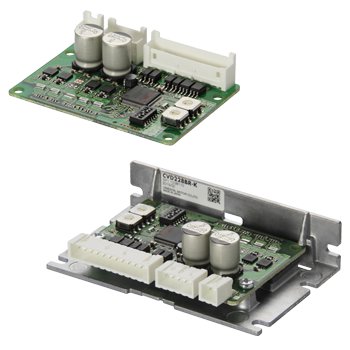
CVD 2-phase bipolar drivers: board-only (top) and with mounting plate (bottom)
About the Oriental Motor CVD / CVK Stepper Drivers & Packages
Oriental Motor CVD series stepper motor drivers are compact microstepping drivers for 2-phase and 5-phase stepper motors. Smooth microstep drive and a built-in filter cut vibration and noise at low speed, which is where cheaper drivers usually struggle.
CVD drivers are available in pulse-input types for use with any PLC or motion controller, and in RS-485 communication types with built-in positioning so a PLC can command moves over Modbus without a separate pulse generator. The CVK series combines a motor and driver into a ready-matched package for OEM machines.
AB Automation supplies CVD drivers and CVK packages across India, helps match the driver current to your motor, and supports wiring and parameter setup during start-up.
A stepper motor driver does two jobs: it turns step commands into switched current in the motor windings, and it decides how smoothly that current changes from one step to the next. CVD drivers are fully digital. A CPU works out the current for each phase and shapes it as a sine wave instead of the older trapezoidal waveform, so the motor microsteps across its whole speed range, not only at low speed. The Smooth Drive function divides each full step automatically (up to 2,048 divisions internally), which means the PLC can keep sending the same pulse count and frequency while the motor runs noticeably quieter.
The range is built around Oriental Motor's PKP Series motors. The 2-phase and 5-phase drivers share the same size, mounting holes and I/O connectors, so you can try a 1.8° motor and a 0.72° motor on the same machine and keep whichever performs better, with no panel redesign. Each driver comes in three mechanical forms: a bare board, a board on a mounting plate, and a mounting plate with right-angle connectors for shallow enclosures.
The control interface is chosen separately from the motor. Pulse-input drivers take pulse/direction from any PLC or motion card. RS-485 drivers store up to 256 moves and run them over Modbus RTU. The fully closed-loop type corrects the final position from an external linear or rotary encoder. The S Type is a small module you solder onto your own PCB, the 4-axis type runs four motors over EtherCAT, and the CVK SC package gives simple two-speed control with no pulse generator. On many OEM machines, one family can cover every stepper axis.
Key features
2-phase and 5-phase types
Pulse-input or RS-485 communication types
24 VDC input, 0.5 A – 4.5 A
Selectable step angle & microstepping filter
Alarm outputs, space-saving design
How to choose a CVD stepper motor driver (selection guide)
Choose the motor first, then the driver. The driver has to match the motor's phase count (2-phase or 5-phase) and its rated current. Oriental Motor publishes a combination table that pairs each PKP or PK motor with a CVD model. If you are replacing a motor, the rated current on the nameplate tells you which driver to use.
Next, decide how the machine will command the axis. This matters more than any other choice, because it sets your PLC hardware and your programming effort.
PLC with high-speed pulse outputs, or synchronised multi-axis motion: pulse input type (CVD2xx / CVD5xx).
PLC without pulse outputs, or many point-to-point axes on one line: RS-485 communication type (CVD2B-KR / CVD5B-KR) over Modbus RTU.
Sub-micron final positioning, such as optics or wafer alignment, at lower cost than a servo: fully closed-loop type (CVD5B-KF) with a linear encoder.
Your own controller PCB with high volumes: S Type board module with I/O or SPI control.
Four or more axes in one compact machine with an EtherCAT master: CVD4A-KED 4-axis driver.
Constant-speed conveying where the motor must hold position when stopped: CVK SC speed control package.
Check the mounting style (board, mounting plate or right-angle connector) against your enclosure depth, and size a 24 VDC supply with the current capacity listed for the driver.
2-phase vs 5-phase CVD drivers: which should you choose?
A 2-phase motor takes 200 full steps per revolution (1.8°). A 5-phase motor takes 500 (0.72°), because its stator has 10 poles instead of 8. With more phases sharing the torque, the torque ripple of a 5-phase motor is much lower, so it runs more smoothly, overshoots less, and is less likely to lose step at start and stop. Oriental Motor's comparison puts the peak-to-valley torque ripple at up to about 29 % for 2-phase and about 5 % for 5-phase.
2-phase is the economical, high-torque choice, and it is the most common motor type in general machines. Choose 5-phase when vibration, noise or fine resolution limit the process, for example in inspection cameras, dispensing, lab automation or feeds for delicate products. Because CVD 2-phase and 5-phase drivers share the same footprint and connectors, you can test both on the prototype before you freeze the bill of materials.
Microstepping, Smooth Drive and vibration control
Microstepping splits each full step by shifting current gradually from one phase to the next. CVD drivers offer 16 resolution settings, from full step up to 51,200 P/R on 2-phase and 125,000 P/R on 5-phase. Finer resolution makes motion smoother. It does not make the motor more accurate than its mechanical specification of about ±0.05°, so choose resolution for smoothness and for easy pulse maths, not as an accuracy figure.
Smooth Drive handles the smoothness side for you. The driver subdivides steps internally, so a PLC sending 200 pulses per revolution still gets quiet, fine-grained motion. For low-speed indexing on legacy controllers, this often solves the problem without any program change. The command filter softens starts and stops, which helps with loose belts or tall loads, but it slightly reduces how closely the motor follows the pulse train. Leave it off for synchronised multi-axis moves.
Set the operating current (RUN switch) no higher than the motor's rated current. Lower it if there is torque margin, to reduce motor temperature.
Standstill current drops automatically to 25 % or 50 % after the motor stops, which cuts heat on axes that stay parked for long periods.
The STEP, 1P/2P and resolution switches only take effect after the power is switched off and on again.
Wiring a CVD driver to a PLC: pulse/direction and RS-485 Modbus
Pulse input type: connect the PLC's positioning outputs to PLS (pulse) and DIR (direction), or CW/CCW in 2-pulse mode, and set the 1P/2P switch to match. Line-driver outputs accept up to 1 MHz and open-collector outputs up to 250 kHz. The inputs are designed for 5 VDC, so a 24 VDC PLC output needs a series resistor (Oriental Motor suggests 1.5 – 2.2 kΩ, 0.5 W for the pulse inputs). Wire ALM back to a PLC input so a driver fault stops the sequence. Use twisted-pair I/O cable and keep it under 2 m, routed away from motor and power cables.
RS-485 type: daisy-chain up to 31 drivers from one PLC or HMI port, set a unique slave address on each, and switch on the 120 Ω termination resistor at the last driver. Keep the total bus length within 10 m. Moves such as positioning, homing and continuous run are stored as operation data and triggered by Modbus register writes. Direct data operation writes a new position or speed and starts the move in the same command. The free MEXE02 software over USB lets you set up and test each axis before the PLC program is ready.
Replacing old stepper drivers with CVD
Many Indian machines still run older Oriental Motor drivers (the earlier CMK and CRK generations), or drivers from builders who have since closed. To replace one, first confirm the motor's phase count, winding type and rated current. 5-phase motors must stay on a 5-phase driver, and a 2-phase unipolar motor may need rewiring or a new bipolar motor.
CVD drivers run on 24 VDC. If the old unit was an AC-input driver, you will need a DC supply of the right capacity, and you should check that top-speed torque is still enough at 24 V. Map the old step angle setting to the CVD STEP switch so the PLC's pulse-per-millimetre scaling stays the same. On a machine you plan to keep for years, this is also a good time to consider a CVK package or an AZ Series closed loop axis. Send us the old driver and motor nameplates and we will suggest a direct CVD match.
Overheat, overvoltage, overcurrent, EEPROM and CPU error, shown by PWR/ALM LED blink count
Operating environment
0 to +50 °C (non-freezing), 85 % RH or less (non-condensing), install inside an enclosure
Product line-up
Type
Description
Key ratings
CVD205 – CVD245 (2-phase, pulse input)
Bipolar drivers for PKP 2-phase motors from 20 mm up to 85 mm frames (PKP213 – PKP29). Board, mounting-plate (B) and right-angle connector (BR) versions.
0.5, 0.6, 1.5, 2.3, 2.8, 4.2 and 4.5 A/phase
CVD503 – CVD538 (5-phase, pulse input)
Drivers for PKP/PK 5-phase motors, plus DRL II compact linear actuators and DH hollow rotary actuators. Board, B and BR versions.
0.35, 0.75, 1.2, 1.4, 1.8, 2.4, 2.8 and 3.8 A/phase
CVD2B-KR / CVD5B-KR (RS-485 communication)
Built-in positioning with 256 operation data points over Modbus RTU. Motor chosen with a setting switch. Right-angle connector versions: CVD2BR-KR / CVD5BR-KR.
5-phase: 0.35 – 2.4 A/phase
CVD5B-KF / CVD5BR-KF (fully closed-loop)
5-phase driver that reads an external linear or rotary encoder and corrects the final position after an open-loop move. Supports RS-485/Modbus RTU.
0.35 – 2.4 A/phase
CVD5H / CVD5V (S Type board module)
Small module for mounting directly on your own PCB, horizontal (H) or vertical (V). I/O-setting or SPI-communication (-KS) versions. 2-phase versions also exist.
0.35 – 2.4 A/phase (5-phase)
CVD4A-KED / CVD4AR-KED (4-axis EtherCAT)
A single board runs four 2-phase or 5-phase axes, which can be mixed, over one EtherCAT cable. Includes encoder input and brake control.
0.5 – 3.0 A per axis, 12 A max total
CVK Series motor + driver packages
Matched PKP motor and CVD driver sold as one package. 1.8° types for high torque at low speed; 0.72°/0.36° types for low vibration and accuracy.
CVK SC (speed control package)
5-phase motor and driver that turns while the FWD/REV input is ON and stops as soon as it goes OFF. No pulse generator needed.
Two speed settings, 0.02 – 600 r/min
Specifications are indicative. Contact us for the exact model, availability, lead time and pricing.
Use cases
Pharmaceutical
Blister-pack indexing feeder
A 5-phase PKP motor on a CVD5 pulse-input driver indexes the forming web by a fixed pitch per cycle. With Smooth Drive and 0.72° base steps, low-speed indexing stays quiet and the web does not jerk.
Smooth, repeatable pitch feed without a servo
Textile
Yarn guide traverse on a winding machine
A 2-phase CVD driver takes high-frequency pulses from the machine controller to drive a belt-driven traverse. Full-time microstepping keeps vibration low through the mid-speed range, where ordinary stepper drives tend to resonate.
Less mid-speed resonance and noise on the machine
Diamond & jewellery
Diamond inspection and marking stage
Compact 5-phase axes on CVD drivers position the stone under the camera or laser in fine increments. Where sub-micron final positioning is needed, the fully closed-loop CVD5B-KF corrects position from a linear encoder.
Fine, vibration-free positioning at stepper cost
Packaging
Label applicator and web feed
A PLC with pulse outputs drives a 2-phase CVD on the label-web axis, and the ALM output is wired back to the PLC to stop the line on a fault. Each label is fed by a fixed pulse count, triggered by a sensor.
Accurate label pitch with simple PLC logic
Food & beverage
Multi-station dosing line over Modbus
Several RS-485 CVD drivers share one Modbus RTU line from the PLC or HMI. Each stores its dose strokes as operation data, so no pulse outputs or extra positioning modules are needed.
Up to 31 axes on one serial cable
Laboratory & medical
Sample tray and pipette axes in an analyser
Board-type or S Type CVD drivers fit inside the instrument, running quiet 5-phase motors that move tray and pipette axes. The S Type's SPI control removes the need for a separate pulse-generator IC.
Quiet operation and a smaller electronics board
Electronics manufacturing
Retrofit of an obsolete stepper drive on a PCB router
An old driver with no spares is replaced by a CVD matched to the existing motor's phase and current. The step angle is set to match the old scaling, so the CNC program runs unchanged.
Machine back in production without reprogramming
Automotive components
Accumulation conveyor with position hold
A CVK SC package runs a short transfer conveyor at a set speed while the PLC input is ON and stops as soon as it goes OFF. Unlike a coasting AC motor, the stepper holds position when stopped.
Consistent stop position without an inverter or brake
OEM machine axes
Conveyors and indexing
Printing and marking machines
Laboratory automation
Retrofit of old stepper drives
Case studies
Inspection equipment
Cutting wiring and driver stock on XYZθ inspection equipment
Challenge
Multi-axis inspection machines normally need a separate driver for every stepper motor. That means a large number of wires and a driver inventory that grows with every motor model used.
Solution
Oriental Motor proposed the CVD Series 4-axis EtherCAT driver (CVD4AR-KED). One board controls four axes and can mix 2-phase and 5-phase PKP motors, geared motors and actuators, with the current for each axis set over EtherCAT.
Result
According to Oriental Motor, one driver now covers four axes. This reduces wiring, machine footprint and the number of driver part numbers to stock, and it allows 2-phase axes for torque and 5-phase axes for low vibration in the same machine.
Replacing in-house stepper drivers in specimen analysis equipment
Challenge
An analyser builder used stepper drivers designed in-house. The ICs it depended on went out of production, and the substitute ICs caused quality problems, which put product supply at risk.
Solution
The builder switched to the CVD Series S Type board module. It comes with the microcontroller, FETs and current-sensing parts already fitted, mounts directly on the equipment's own PCB, and accepts SPI commands for position and speed.
Result
Oriental Motor reports a more secure component supply, fewer maintenance parts to manage, no pulse-generator IC, and lower vibration and noise than the previous in-house drivers.
Lower-cost fully closed-loop alignment for precision optics
Challenge
Assembly errors and small stage vibrations were limiting alignment accuracy. The existing servo-based fully closed-loop system cost more than the equipment budget allowed.
Solution
A CVD fully closed-loop control driver was paired with a harmonic-geared 5-phase PKP stepper. The stage moves open-loop, then a linear encoder feeds back to the driver, which corrects the final position.
Result
Oriental Motor describes sub-micron final positioning with a zero-backlash geared stepper, at a lower system cost than the servo approach, and with no gain tuning.
Meeting semiconductor miniaturisation with closed-loop steppers
Challenge
Shrinking process geometries needed better alignment accuracy than the equipment could deliver, and the stage had to settle completely and quickly when it stopped.
Solution
The CVD fully closed-loop type with a linear encoder drives a 5-phase stepper open-loop for a fast response, then corrects the position from the encoder once the command has finished.
Result
Per Oriental Motor, positioning reached the sub-micron range, limited by the encoder's resolution. The stepper stops without hunting and needs no servo-style gain adjustment.
Genuine Oriental Motor products with warranty, supplied pan-India from Surat, Gujarat.
Selection calculations from your load, speed and positioning requirements.
Wiring, parameter setup, PLC integration and on-site start-up support.
Replacement models for older Oriental Motor products on existing machines.
Frequently asked questions
Can a CVD driver be controlled directly by a PLC?
Yes. Pulse-input CVD drivers accept pulse/direction signals from a PLC positioning output, and RS-485 types can be commanded over Modbus RTU without pulse outputs.
What is the difference between 2-phase and 5-phase stepper drivers?
5-phase systems have a smaller basic step angle (0.72°), giving smoother motion and lower vibration; 2-phase systems (1.8°) are the most widely used and economical. The driver must match the motor’s phase type.
Can I replace an old stepper driver with a CVD driver?
Often yes, if the motor phase type and current match. Share the existing motor and driver details and we will confirm a compatible replacement.
What power supply does a CVD stepper driver need?
All CVD drivers run on 24 VDC ±10 %. Size the supply for the driver model. Oriental Motor lists figures from about 0.5 A for the smallest 2-phase driver up to 4.8 A for the largest 5-phase drivers. Use a DC supply with reinforced insulation.
What is the maximum pulse frequency a CVD pulse-input driver accepts?
Up to 1 MHz from a line-driver output and 250 kHz from an open-collector output, at 50 % duty. Both 1-pulse (pulse/direction) and 2-pulse (CW/CCW) modes can be selected with a switch.
How many CVD RS-485 drivers can I connect to one PLC?
Up to 31 drivers on one Modbus RTU line, with a total bus length of up to 10 m. Each driver stores up to 256 operation data points, so the PLC only selects and starts moves.
Does a higher microstep setting make the motor more accurate?
Not beyond the motor's mechanical accuracy of about ±0.05°. Higher resolution gives smoother, quieter motion and finer command increments. CVD drivers' precise current control helps stop accuracy when microstepping, but for guaranteed position you need an encoder or a closed loop system.
Can one CVD driver run both 2-phase and 5-phase motors?
Standard pulse-input drivers are either 2-phase or 5-phase models. The CVD4A-KED 4-axis EtherCAT driver can run 2-phase and 5-phase motors together on its four axes.