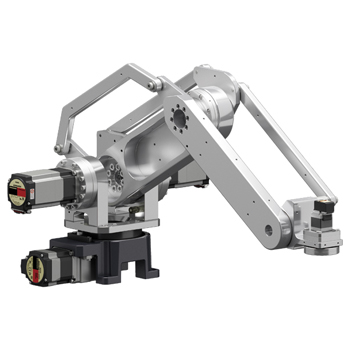
The Oriental Motor OVR Series is a family of small industrial robots designed to make robot automation simple and affordable for small and medium manufacturers. The range covers 4-axis (parallel link), 5-axis and 6-axis articulated arms, 3-axis SCARA robots and a 3-axis Cartesian robot, all running on 24 VDC with αSTEP AZ Series motors and the battery-free ABZO absolute sensor on every axis.
OVR robots are controlled by the MRC01 robot controller and programmed in the free MRC Studio software with a setup wizard and drag-and-drop commands — no robot language or ladder logic. A free 3D simulator lets you check the program before the robot arrives, and the controller connects to a PLC over EtherNet/IP or I/O.
Their compact size lets you automate a single repetitive task — pick-and-place, loading, sorting, palletising or simple assembly — without redesigning the line. AB Automation is an authorised Oriental Motor distributor and robotics integrator: we help you choose the right OVR type, program and simulate the application, and provide on-site start-up anywhere in India.
The OVR family is not one robot but three robot types sharing the same building blocks. There are vertical articulated arms with 4, 5 or 6 axes, 3-axis horizontal articulated (SCARA-type) arms, and a 3-axis Cartesian robot made from three electric linear slides. Every axis on every model is driven by a standard αSTEP AZ Series DC-input motor, and the whole range runs from a 24 VDC supply. Payloads run from 1 kg to 10 kg and horizontal reach from 350 mm to 880 mm, so OVR sits clearly in the small-robot class, the size you use for handling parts, trays, vials and small cartons rather than engine blocks.
Because the joints use catalogue AZ motors, each axis carries a battery-free ABZO multi-turn absolute sensor. That means no encoder battery to replace, no external home or limit sensors to wire, and no homing routine after a power cut. Oriental Motor also designs the motors to be customer-replaceable: if an axis fails, a maintenance team can fit a stock AZ motor instead of waiting for a proprietary robot joint. For Indian plants that run far from a robot OEM's service centre, this is often the deciding practical advantage.
Control comes from the MRC01 robot controller (MRC01-C for the Cartesian robot) or the MRCU Series, which packs the MRC01 and the AZ drivers into one A4-size box. The robot is set up and programmed in MRC Studio, a free PC tool with a set-up wizard for choosing the robot type and a drag-and-drop command list instead of a robot language or ladder logic. A PLC can command the robot over EtherNet/IP or simple I/O, and the free MRC Studio Simulator lets you build and time a program in 3D before any hardware arrives. Note that OVR robots are industrial robots, not cobots, so they need normal guarding and a risk assessment.
Key features
Articulated (4/5/6-axis), SCARA and Cartesian types
AZ Series motors with battery-free ABZO absolute sensors on every axis
MRC01 controller with free MRC Studio drag-and-drop programming and 3D simulator
24 VDC operation, EtherNet/IP and I/O connection to PLCs
What makes OVR different from a conventional industrial robot
A typical SCARA or 6-axis robot arrives as a sealed package: proprietary servo joints, a dedicated controller, a teach pendant and a robot language your team has to learn. That is the right choice for high-speed, high-payload cells, but it is heavy on cost and specialist skills for a plant that only wants to automate one loading or sorting job.
OVR takes the opposite approach. The arms are deliberately simple aluminium structures driven by standard AZ Series motors on 24 VDC. You can buy spare motors off the shelf, swap them yourself, and set the robot up from a PC without a pendant. The trade-off is honest: payloads stop at 5 kg on the articulated arms (10 kg maximum on one SCARA model), and speeds are modest. OVR is aimed at the large middle ground of small, repetitive tasks where a big robot is overkill and a pneumatic pick-and-place is too inflexible.
All axes on standard αSTEP AZ motors with battery-free absolute sensors
24 VDC input, so battery operation on an AGV/AMR is possible
Customer-replaceable motors keep downtime and spares cost low
Programmed from a PC in MRC Studio: no robot language, no ladder logic
Industrial robots, not cobots: plan guarding and safety accordingly
How to choose an OVR robot: type, reach and payload (selection guide)
Start with the motion, not the robot. If the part simply moves from one flat position to another on a table or conveyor, a SCARA or a 4-axis parallel-link arm is usually enough. If the part has to be tilted, turned over or approached from the side, you need the wrist freedom of the 5-axis or 6-axis arm. If the work area is a rectangle and you care most about accuracy and rigidity, the Cartesian robot is the simplest and most precise option.
Then check payload including the gripper. The 5-axis and 6-axis arms carry 1 kg, and an electric gripper can use a good part of that, so weigh the complete end effector. The 4-axis arm (5 kg) and the Full 360° SCARA (10 kg maximum, 3 kg rated) suit heavier trays and cartons. Finally size the reach: draw the pick and place points on the layout and make sure both sit comfortably inside the working envelope, not at its edge.
One point often missed: the OVR SCARA has no built-in vertical (Z) axis. Its three axes are the two arm joints and a rotating tip axis. Vertical motion comes from a separate mechanism, such as an EL Series electric lifting column under the robot, a DR Series compact electric cylinder at the tip, or a linear actuator, and the MRC01 controls these too. That design is what keeps the arm only about 56 mm thick, but you must include the lift in your selection.
Flat transfer, conveyor to conveyor: OVR3041K3-H SCARA or OVR4 4-axis
Heavier load or full-circle work zone: OVR3046K10-H Full 360° SCARA
Long reach across a wide bench: OVR3070K3-H (700 mm) or OVR4088K5-V (880 mm)
Tilt, flip or side approach: OVR5035K1-V or OVR6048K1-V
Weigh the gripper and the part together against the rated transportable mass
Programming and simulation with MRC01 and MRC Studio
MRC Studio breaks start-up into three steps: initial settings, operation programming and operation check. The set-up wizard asks you to pick the robot type; for OVR models the arm dimensions are already stored, so you mainly enter the end effector and axis settings. Oriental Motor says a newcomer can learn the software in about 30 minutes.
Programs are built by dragging commands into a sequence and filling in values. The controller handles point-to-point moves, linear, circular and arc interpolation and palletizing patterns, and it stores the kinematics so you work in X-Y-Z coordinates rather than joint angles. A PLC then starts programs and passes data over EtherNet/IP, or through eight digital inputs and outputs if you prefer simple wiring. For vision-guided picking, MRC Studio includes a calibration routine to convert 2D camera coordinates into robot coordinates.
Before buying, the free MRC Studio Simulator lets you build a program and watch it run in 3D, and those programs can be reused on the real robot. The MRC Reality app shows a virtual OVR robot in your actual workspace on an iPhone or iPad, which is a quick way to check whether it fits between existing machines. AB Automation uses these tools to prove the cycle and layout with you before an order is placed.
OVR vs a standard SCARA or 6-axis robot: which should you choose?
Choose a conventional SCARA or 6-axis industrial robot when you need high speed, payloads above 5–10 kg, very short cycle times or a fully enclosed high-throughput cell. Those robots have far more powerful servo joints and are the right tool for high-volume assembly and heavy handling. AB Automation also integrates these, including Mitsubishi Electric robots.
Choose OVR when the task is light and repetitive, space is tight, and the priority is a low entry cost and in-house maintainability. The flat SCARA can reach through openings and under shelves where a tall SCARA body would clash, and the 5-axis and 6-axis arms weigh only 12.5 kg, so they can be mounted on a linear slide or moved between stations. Because everything runs on AZ motors, the same maintenance team that looks after your AZ-driven machines can support the robot.
Payload: OVR 1–10 kg vs typically much higher on standard industrial robots
Programming: MRC Studio drag-and-drop vs proprietary robot language and pendant
Maintenance: stock AZ motors, customer-replaceable vs OEM joint service
Power: 24 VDC vs mains-powered robot controllers
Return on investment for small and medium manufacturers
For most SMEs the business case for a small robot is simple: one repetitive station, often on two or three shifts, that currently ties up an operator and produces inconsistent output. The savings come from redeploying that operator to value-adding work, fewer handling errors and damaged parts, and steadier cycle times. The costs to weigh are the robot and controller, the gripper, guarding, integration and training.
OVR helps on the cost side in three ways. Integration is lighter, because the set-up wizard and command-based programming cut engineering hours and a PLC programmer can take over without robot training. Spares are standard AZ catalogue items rather than robot-specific assemblies. And the robot can be simulated and tested with your parts before purchase, which reduces the risk of a system that does not meet the cycle. We recommend calculating payback on the real shift pattern and the realistic cycle time proved in simulation, not on best-case figures.
Articulated 1 kg (5/6-axis) or 5 kg (4-axis); SCARA 3 kg, or 10 kg max on OVR3046K10-H; Cartesian 2.5 kg
Maximum reach
Articulated 350–880 mm horizontal; SCARA 410, 460 or 700 mm; Cartesian 300 × 300 × 100 mm (X-Y-Z)
Repeatability
±0.05 mm articulated; ±0.03 to ±0.08 mm SCARA (by model); ±0.02 mm Cartesian
Standard cycle time
0.7 s (4-axis and 6-axis), 0.9 s (5-axis), 1 kg load, 25 mm up / 300 mm across, with MRC01
Power supply
24 VDC for all robot arms (recommended supply 170 W SCARA, 500 W 4-axis, 600 W 5/6-axis)
Drive motors
αSTEP AZ Series DC input on every axis, battery-free ABZO multi-turn absolute sensor, no external home sensors
Robot controller
MRC01 (MRC01-C for Cartesian) or MRCU integrated controller + drivers; up to 8 control axes, one robot per controller
Interfaces
EtherNet/IP to host PLC, 8 inputs / 8 outputs, RS-485 (Modbus RTU) to AZ drivers, USB 2.0 to PC
Programming
MRC Studio (free): wizard set-up, drag-and-drop commands, P-to-P, linear, circular and arc interpolation, palletizing; free MRC Studio Simulator and MRC Reality AR app
Product line-up
Type
Description
Key ratings
OVR4048K5-V / OVR4068K5-V / OVR4088K5-V
4-axis vertical articulated with parallel link, keeps the tool level for horizontal transfer and palletizing
5 kg; 480 / 680 / 880 mm horizontal reach (580 and 780 mm possible by recombining arms); ±0.05 mm; 0.7 s cycle
OVR5035K1-V
5-axis vertical articulated, 12.5 kg body, 130 × 130 mm footprint, light enough to ride on a linear slide
1 kg (2 kg at 48 VDC, consult); 350 mm horizontal reach; ±0.05 mm; 0.9 s cycle
OVR6048K1-V
6-axis vertical articulated with harmonic drive gearing, approaches the part from angles a 5-axis arm cannot
1 kg; 480 mm horizontal reach; ±0.05 mm; 0.7 s cycle
OVR3041K3-H
3-axis SCARA, Standard Type: flat 7.6 kg arm about 137 mm tall, floor or ceiling mount, lowest cost
3 kg; 410 mm reach (230 + 180 mm arms); axis 1 ±170°; 1000 mm/s; ±0.03 mm
OVR3046K10-H
3-axis SCARA, Full 360° Type with cover and simple dust-resistant structure
3 kg rated / 10 kg max; 460 mm reach; axis 1 ±360°; ±0.05 mm
OVR3070K3-H
3-axis SCARA, Full 360° Type with long stroke arms (350 + 350 mm), IP40
1 kg rated / 3 kg max; 700 mm reach; axis 1 ±360°; ±0.08 mm
OVR3AL030030Z10K-C / OVR3AR030030Z10K-C
3-axis Cartesian robot (L and R types), three linear slides delivered assembled, Z axis with brake
2.5 kg; 300 × 300 × 100 mm; 600 mm/s per axis; ±0.02 mm
MRC01 / MRC01-C / MRCU Series
Robot controllers: MRC01 for articulated and SCARA arms or custom AZ mechanisms, MRC01-C for the Cartesian robot, MRCU = controller and AZ drivers in one A4-size unit
24 VDC; EtherNet/IP; 8 in / 8 out; up to 8 axes
Specifications are indicative. Contact us for the exact model, availability, lead time and pricing.
Use cases
Pharmaceutical
Tray loading on a pharma packaging line
A 4-axis OVR arm transfers filled vials or blister cards from a conveyor into trays in a fixed pattern. The parallel link keeps the tool level throughout the move and the palletizing command in MRC Studio generates the tray grid without teaching every position.
Consistent tray patterns without manual handling
Laboratory / diagnostics
Sample and microplate handling in a laboratory
A Full 360° SCARA moves microplates and tubes between instruments on a crowded bench. Its low arm slips under shelves and into instrument openings, and full rotation lets it serve stations all around its base.
Automates transfers in a compact bench layout
Auto components
Loading a CNC or test fixture
A 5-axis arm on an electric linear slide picks small machined parts from a tray and places them into a gauge or fixture, then returns them. The PLC starts each program over EtherNet/IP and the 24 VDC robot fits inside the machine guarding.
One robot tends several stations along the slide
Electrical & electronics
Vision-guided sorting of small parts
A SCARA picks randomly placed connectors or sensors from a conveyor using position and angle from a 2D camera. MRC Studio's camera calibration converts image coordinates into robot coordinates, and an EH Series electric gripper handles the parts gently.
Sorting without fixtures or manual orientation
Packaging / FMCG
Carton and bag palletizing at line end
A 4-axis OVR4088K5-V with 880 mm reach stacks small cartons or pouches up to its 5 kg rating onto a pallet or into a crate in a programmed pattern. For heavier cases a larger palletizing robot is the better choice.
Removes a tiring, repetitive end-of-line job
Precision engineering
Precise pick-and-place for small assembly
The 3-axis Cartesian robot, with ±0.02 mm repeatability over a 300 × 300 mm area, presses or places small components into housings. It arrives with its three slides assembled, so the machine builder only adds the tooling.
Accurate placement with minimal mechanical design
Diamond & jewellery
Handling delicate stones or jewellery components
A flat SCARA moves stones or small findings between trays, inspection stations and fixtures, with the gripping force of an electric gripper set finely so parts are not scratched. The robot's small footprint suits compact benches common in Surat units.
Gentle, repeatable handling of high-value parts
Textile
Bobbin and component transfer in textile machinery
A 4-axis or SCARA arm moves light bobbins, cones or cut parts between a conveyor and a machine feed. Because every axis uses AZ motors, the plant's existing Oriental Motor spares and skills cover the robot too.
Automation that the plant's own team can maintain
Pick-and-place and sorting
Machine loading and unloading
Small-part assembly
Palletising
Laboratory and packaging tasks
Case studies
Parts manufacturing
Automating manual palletizing with a pre-assembled Cartesian robot
Challenge
Parts plants were palletizing by hand, which tired workers and gave uneven output. A typical industrial robot was oversized and costly for the job, and usually needed an outside systems integrator.
Solution
Oriental Motor proposed the OVR 3-axis Cartesian robot (300 × 300 × 100 mm, 2.5 kg) with the MRC01-C controller, three AZD-KD drivers and MRC Studio. The robot arrives with its linear slides assembled, and vision sensors can be added for more advanced operation.
Result
Assembly man-hours for the mechanism were eliminated, parts ordering was simplified, and the palletizing program could be created by staff without robot experience. The published case study does not quote throughput figures.
Converting a manual sensor assembly line with SCARA and gantry robots
Challenge
A factory team wanted to turn a manual sensor assembly line into an automated one while keeping the footprint small and raising throughput.
Solution
They built a horizontal SCARA robot and a Cartesian/gantry robot from AZ Series motors, DGII hollow rotary actuators, DR Series linear actuators and EH Series electric grippers, all coordinated by the MRC01 controller and programmed in MRC Studio. The two robots work in parallel.
Result
Several separate processes were combined and overall machine time dropped because the robots work simultaneously.
Warehouse picking, packing and unpacking demonstration with two OVR arms
Challenge
Oriental Motor's application engineering group set out to show how small robots could cover a full warehouse flow: picking, packing, shipping, receiving, unpacking and stocking.
Solution
A 5-axis OVR arm with an electric gripper and linear actuator handles pick-and-place, while a 4-axis OVR palletizer arm unpacks with suction cups. MRC controllers run both robots and also control the BLH Series brushless conveyors directly, triggered by laser sensors, with a vision system locating parts.
Result
The demonstration shows two small robots and their conveyors coordinated from MRC controllers without a separate motion system. It is a vendor demonstration, so no production figures are published.
OVR is Oriental Motor’s series of small, low-cost industrial robots — articulated, SCARA and Cartesian types — built on AZ Series motors for simple automation tasks that do not need a large industrial robot.
Is an OVR robot difficult to program?
No. OVR robots are programmed in the free MRC Studio software with drag-and-drop commands and a setup wizard, and AB Automation provides programming support and training.
How is an OVR robot different from a standard industrial robot?
Standard industrial robots are built for high speed and heavy payloads in dedicated cells. OVR robots focus on simplicity, compact size and low cost for light payloads (1 – 5 kg) and single, repetitive tasks on existing lines. We supply both and will recommend the right fit.
Are OVR robots collaborative robots (cobots)?
No. OVR robots are not cobots, so they need guarding or safety measures appropriate to your risk assessment, like other industrial robots.
Can I test an OVR robot before buying?
Contact us with your application. We offer selection support and 3D simulation, and testing support with actual equipment.
Which OVR robot types and axis counts are available?
OVR comes as 4-axis, 5-axis and 6-axis vertical articulated arms (OVR4048K5-V, OVR4068K5-V, OVR4088K5-V, OVR5035K1-V, OVR6048K1-V), 3-axis SCARA arms (OVR3041K3-H, OVR3046K10-H, OVR3070K3-H) and a 3-axis Cartesian robot (OVR3AL/OVR3AR030030Z10K-C).
What payload and reach can OVR robots handle?
Payload is 1 kg on the 5-axis and 6-axis arms, 5 kg on the 4-axis arms, 3 kg on the SCARAs (10 kg maximum on OVR3046K10-H) and 2.5 kg on the Cartesian robot. Horizontal reach ranges from 350 mm to 880 mm, and the Cartesian robot covers 300 × 300 × 100 mm.
Does the OVR SCARA have a vertical Z axis?
No. Its three axes are two arm joints and a rotating tip axis. Vertical movement is added with an EL Series electric lifting column, a compact electric cylinder or a linear actuator, which the same MRC01 controller can drive.
Can a PLC control an OVR robot?
Yes. The MRC01 and MRCU controllers connect to a host PLC over EtherNet/IP, or through 8 digital inputs and 8 outputs. The PLC selects and starts programs stored in the controller, so no robot language is needed on the PLC side.
Is the OVR a collaborative robot?
No. Oriental Motor states that OVR robots are not cobots. They must be installed as industrial robots with appropriate guarding, safety devices and a risk assessment.